
By Vivian Hansen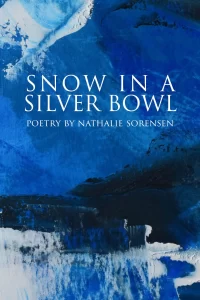
Snow In A Silver Bowl
by Nathalie Sorensen
Frontenac House (2026)
Sometimes I crave the presence of a collection of words that affirm my era of feminism in which I participated with half-hearted illusion. Sorensen’s work offers snapshots of those days. And they are no longer half-hearted but fully embossed with nostalgia. Sometimes I don’t want to lick my finger to turn the page; I know it will turn without the effort of what is wet. Nathalie Sorensen’s debut collection is one such poetry book that keeps me turning in resistance to all things that are inaccessible to me.
Even so, the wet enters the motion of turning: “this is the river, ravishing, /unknowable, itself.” (14) These poems are the river, the essence of a self that craves affirmation in the lucid, hard dreams of a life. Sorensen uses this word at a frequency I find intriguing, “… a lucid blade of grass,”(15). What is lucid, after all, but a waving handkerchief, a sometime sorrow that reminds us of what we cannot stash aside.
And then come the images. These are holy in their poetic magnification: the numinous hallucinations that heal (20) where the lion sits down with a carried Caro (a friend dying of cancer). Perhaps the most poignant parable is found in “when an old fireplace/is lit again, the old people come back.” (23) This place is the ‘rest hard’ industry of memoir and how one creates space for the healing.
Commas are breath stops, where the narrator demands an audience. Commas infiltrate so many lines in this work; I am stunned by the craft that leads to stillness within a false capitulation to power structures in punctuation and politics. The commas also emulate a kind of recipe and second person solution:
Look up.
Stars, nebulae, quasars
galaxies, supernovae;
a small part of all there is (35)For weeks, months, years
make ink. Grind the inkstick
in the shallow stone bowl
until your arm aches,
until the ink is impeccable,
a true dark. (35)
This is not the only recipe form. I would argue that Sorensen has drawn a new form from the intertexts of women. This is exciting [dis]covery for an old feminist.
For regular draughts around the eaves,
wind chimes will do. Find small shards of glass,
marine blue, carmine, mauve, and rose.
Drill holes. Suspend them on strings from a hoop.
Small tinkles and pings tell stories of the household,
who has come, who has gone, who won’t come back.For wilder breezes, an Aeolian harp is best.
Set it on rocky crags above the seato wail and haunt the shore. …(16)
She listens. She has time; a thing of great consequence for a busy woman.
This is the measure of years for a woman, but like the early feminist confessional poetry, the poet grows a tantalizing close watch in the magic realism of the laundry. It is that horse rising from the aquarium that we always suspected was there, but never really sure.
A large aquarium full of water
against the far wall:
sand, stones, plants.
And one small horse grazing.
I approach the tank, the horse rears up.
His head emerges from the water,
his face beautiful. (37)
Sorensen reactivates the sensibility of second wave feminism, which I am rediscovering in more contemporary forms. It remains a foundational discourse. Activists of liberal feminism drew attention to the private world of women as lived in domestic labour, sexuality, and family roles. As much as these roles were systemically constructed, I recognize the old filters of laundry, dishes, taking the kids to baseball practice, and single-parenting when there is never enough of anything to meet demands. There is, however, a beautiful horse in the aquarium to break the monotony.
So let us speak of escape. Sorensen’s work offers a hidden tunnel of flight. A mixed metaphor, to be sure, but necessary to the experience of getaway. Somehow, tunnels and flight affirm my ability to see the problem and act with a sense of agency. I can lie down with the lions and the laundry and simply observe. I can also live inside the stories of Jewish women long gone with the aural echoes of a baby’s cry; the refusal to speak of horrors until they have become crones and pass their stories onto me – dear reader.
I am not entirely convinced that Earth “shrugs off the noose of language” (33) but I will indulge the poet to perceive, more fully, her images. Then she offers: “only fall silent,/listen with an inner ear,/there it is… a mourning dove calls, once, twice, flies away. Silence.” (33-34). The act of language, of poetry, offers a linguistic grid of how to apprehend a knowing. The noose of language is always fluid and malleable, always evolving, and where it shocks the senses outside of ocular knowing, the poet is successful in attaining and attracting a new sensibility. In the inference of the senses, now articulated, witness this escape:
From The Unicorn in Captivity (Unicorn Tapestries, 1495-1505, MET Museum)
He bleeds.
Drops, red as berries,
Spot his white coat.
Around him, flowers, bluebells,
oxlip, bistort, cuckoopint,
woven with botanical care,
tinted with madder, turmeric, woad.Who among us will breach the fence,
unbuckle his harness,
help him to his feet,
and lead him into the bluebells?
Who among us seems not to have changed in more than 500 years, and this is an unsettling apprehension of how the human voice just cannot catch, a moral force. Best to allow the unicorn the bluebells he craves.
Lest the modern reader of feminist text dismiss this simple knowing, Sorensen offers another guidance: Lascaux, where she last lay in the grass, a woman comprehends: “deep in the grass, the aurochs pass.” (30) The extinction of a hunted creature is uncertain, but we can lay here for awhile and think on it.
I experience a fine gratification in reading this work; it is an accessible and sensate offering. It does all the heavy lifting and allows me the hard rest I need to pursue the words.
Vivian Hansen’s publications include three full-length books of poetry — including A Tincture of Sunlight and A Bitter Mood of Clouds — and several chapbooks. She has published essays in Coming Here, Being Here, and in Waiting. She also has a short piece in the Calgary Public Library Dispenser Series (2019) Where We Surfaced.