By Robert Hilles 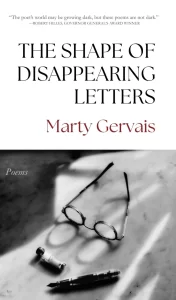
The Shape of Disappearing Letters
by Marty Gervais
Mosaic Press (2026)
Marty Gervais has published twenty-five books that include books of poetry, novels, and nonfiction. He has been awarded the prestigious Harbourfront Festival of Prize and has worked as journalist for The Windsor Star where he’s won nearly twenty Journalism awards. He has twice won the Milton Acorn’s Poetry Prize and has been the Poet Laureate for Windsor. To top all that, he is an amazing photographer and ran Black Moss Press for more than fifty years. Given all that this is his bravest poetry books to date. The key word in the title is Disappearing. In this book, the poet, with much dignity, chronicles how many on his father’s side have suffered from some form of loss of vision later in life. In this book he elaborates on all of that but focuses the most on his father and his dealings with that. He writes not with self-pity but with brave acceptance. Early on he writes about an uncle who also bravely faced a growing blindness (Finding the Garden):
“A glorious hideaway in the dark shadow
of the nearby factory where after the onset
of blindness he lost his job and soon
retreated to this cramped little paradise behind
his house where he could be seen gliding about
with a metal watering can, weaving in and around
this carefully sculpted world he so intimately
knew, almost like when he patrolled Ford’s
assembly lines as a hard—nosed union boss”
This is poem like most in the book the conveys the ability to adapt.
The poet has had to deal with poor vision all this life and it starts as young boy and his first eye exam (Eye Exam):
“‘Boy, his eyes are bad for
a kid so young,’ said the optometrist
when he asked me to read
the eye chart at the end of the room
— the large letter “E” on the top line
leaping and shouting for attention
— a kid in the schoolyard”
His first pair of glasses results in him bullied (First Pair of Glasses):
“Like my father’s — big, black, square
sliding down my nose — my index finger quickly
found a new role pushing these plastic spectacles
back and up into place
I didn’t have them a week when someone punched me
in the face and broke the bridge
I patched it with a brown bandage
forever unravelling”
These early poems help set the stage for what happens years later. First his father loses the ability to drive (The Last Drive Home):
“My father told me how on the last day
he owned a car — having had to give
it up when he failed the eye exam—
he sat in his 1991 Buick in the driveway
hands gripping the steering wheel
like a teenager pretending to drive”
And much later his father continues to work in his workshop despite being essentially blind (The Lesson):
“His hands caressed the two-by-fours
— no different than a blind man searching
the shape of a familiar face — my father
in a new apartment, as he went about
building a work bench, something
he had never been without”
This poem ends with these wise words from the poet’s father (The Lesson):
“‘You don’t need to see,’ he scoffed
‘You know when you’re good!’”
Later still his father lives with his inability to see (My Father Reading):
“My 85-year-old father sat alone —
a mug of coffee beside him
and The Windsor Daily Star spread
flat on a small kitchen table
pretending to read —
eyes straining at headlines
the index finger of his right hand
slowly gliding underneath the words”
A similar fate faces the poet (Like My Father):“My notebooks are looking more and more
like children’s handiwork — the pages
I handed in the nuns in Grade 2,
letters tall and fat, sometimes ragged
odd and happy and frantic, big creatures
waving or dancing or misbehaving”
And as an echo to his father’s pretending to read the poet does something similar (Saving Grace):
“I spread out the map of the world
…My eyes scan the darkening shades
of mountains, greens in the broad plains
deep blues of rivers and oceans and seas
and my hands slide freely across
boundaries like soaring birds above
in the metal grey February weather
no passport, no care as they settle
and light again —”
We eventually come to this (Seeing Him Play – For Julien)
“I can still pick out my six-foot grandson
in these televised varsity hockey games
if I stand just inches away from
the wide screen, straining my eyes
to track his lean and familiar shape
as he maneuvers the puck, smoothly weaving
and bobbing and slipping through
this pinball maze, the brightest of icescapes
a world of blurred jersey numbers
of streaks of light and colour and shadow
and sound and maybe not enough to say
I was therebut still I’ve tasted something
of all that easy grace
and luck and prayer”
The poet is bullied early in life because of his glasses but endures. That is what is strongest about this book and will give every reader hope because no matter the adversity he survives and endures. It would be easy for the poet to feel sorry for himself especially after grandfather, uncles, aunts, and father all struggle with the same loss of sight later in life. It would be easy for the poet to feel cursed or put upon but Marty Gervais does not let that best him. Instead, the good in him endures.
The book ends with this brave author’s note:
“I am going blind. No surprise. My father, my grandfather, various aunts and uncles, all were stricken with macular degeneration (AMD)—one of the most common age-related eye conditions that affects the central part of the retina, called the macula.”
Read these poems and celebrate the human spirit behind them.
Robert Hilles lives in Nanaimo, BC and to date has published twenty-five books. He won the Governor General’s Award for Poetry for Cantos from A Small Room. His books have also been shortlisted for The Milton Acorn People’s Poetry Prize, The W.O. Mitchell/City of Calgary Prize, The Stephan Stephansson Award, and The Howard O’Hagan Award. He has published eighteen books of poetry, four works of fiction, and two nonfiction books.