
By Jonathan Greenbaum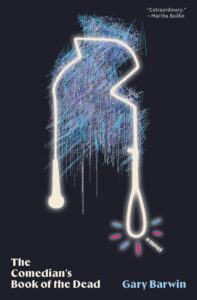
The Comedian’s Book of the Dead
by Gary Barwin
Book*Hug Press (2026)
Writers over the centuries have been inspired by the stories of classical mythology—Dante Alighieri’s The Divine Comedy (completed in 1321) being a famous example. Why, then, shouldn’t a contemporary Canadian fiction writer lean on the Greek myth of Orpheus and Eurydice as his inspiration for a novel?
Hamilton-based writer, musician, and multi-media artist, Gary Barwin, does so in his most recent novel, “The Comedian’s Book of the Dead” (CBOTD). Barwin’s apparent muse is the Orpheus and Eurydice tale. Orpheus loved the beautiful Eurydice. He married her and, for a time, they lived together happily. When Eurydice is bitten by a snake and dies, her grief-stricken husband travels to Hades (the underworld) to find her. His mission: to use his lyre-playing skill to charm Hades and Persephone into releasing Eurydice, so that he can bring her back into world of the living.
Why must the people we love disappear from our lives? Barwin seems to be asking in his novel.
The unnamed, first-person narrator of the CBOTD is both a family man and Death, himself. (Yes, Death. Barwin is betting that we’ll suspend our critical sense of disbelief to find this plausible). The narrator/Death character has given himself a mission: having lost his son, Grigory, to suicide, he attempts, like Orpheus, to locate Grigory’s spirit in the Beneath and return it to earth.
I have done things that make me shudder [says the narrator].
Thousands—millions—of them. But I was not always Death.
I was a husband, a father, a comedian, chosen to replace the
previous Death. It was the ultimate joke. [p. 9]
Lest you think that the CBOTD is a black comedy, be forewarned: I found nothing funny in the novel. The story riffs off of mythology and philosophical questions relating to life and death. It’s an unusual blend of literary realism and mythology. The timelines are unspecified, and the events of the plot unfold in an unnamed city. Barwin has done this to give his story a myth-like quality. The structure of this 226-page novel is episodic: there are no chapters or headings; one section flows into the next, separated only by a dingbat followed by a new page.
Although we are told that the male narrator has worked as a comedian before he was chosen by the Committee to be Death—we never see him perform as such. Can death be funny? I suppose that depends on how one sees it. Here is the narrator:
I have bad news,” I said to Betty. “Terrible news. I
have had a message from the committee. I must
bring Grigory to the Beneath. I begged and argued,
he is too young, just a small boy, he is Grigory, our
Grigory. [p. 24]
The narrator is leading a conventional, suburban life when the story opens. He is married to a woman named Betty, who runs a bakery. Their only child, Grigory, is about six years old.
Does the Death/narrator character succeed in rescuing his lost son? This question gives the novel its throughline. To his credit, Barwin has managed to conjure up a creepy narrative voice for his comedian/Death narrator.
A place. A time. And usually a name. I’d arrive and
say what I was told to say… Here I am. Come with
me. I’d pull out the shadow, lift the fragile wings of
spirit from its now-spent cocoon. [p. 9]
Barwin’s writing is clear and at times strongly evocative. For example, there is a superb description of the young Grigory stepping onto a frozen river and then falling into it.
Grigory closed his eyes, filled his lungs, held his
breath, and stepped off the edge. The scritch of
compressing snow, the unyielding surface of the
ice. Without stopping to worry, he placed his other
foot onto the river, then quickly walked forward. [p. 40]
In this scene—more than in any other—young Grigory, who nearly drowns, comes alive as a character.
Few novels can be said to be without blemish, and this is true of the CBOTD. There are, it seems to me, two weak links in the narrative chain. First, there’s some doubt about the plausibility of the Death/narrator character. How can he both a family man and Death at the same time? (The narrator, himself, seems to recognize this):
I was neither fully Death nor fully human,
and those moments between, though out of
time, had jagged edges. [p. 43]
Second, the novel contains a backstory about Dani and her brother, Lenny, that does not feel directly related to the narrator’s quest. We are told that Dani and her brother fly a kite. They watch TV together. Lenny dies, carried off by the Death/narrator character. This backstory pads out the narrative. Perhaps that’s why it’s there?
In the end, it is for readers to judge the success of the novel.
“The humans here may be dead, but they don’t
change,” I said. “When you die, you lose the
possibility of change. That’s the worst and best
thing about dying.” [p. 72]
The depth of pathos that readers feel for Barwin’s questing narrator will be central to judging the success of his book.
Jonathan Greenbaum, M.Ed. is a retired English high school teacher. A graduate of the Humber School for Writers in Toronto, Jonathan’s short fiction has appeared in The Nashwaak Review. He is currently completing a manuscript of short stories.