By Frances Boyle 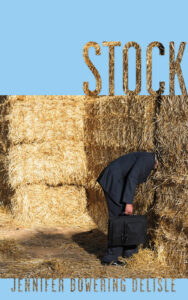
Stock
by Jennifer Bowering Delisle
Coach House Books (2025)
We’ve all seen those smiling faces. Impossibly joyful families, mother impeccably groomed as she serves weekday breakfasts or bakes with her child, a no-nonsense “Lady Boss,” arms crossed and powerful yet totally feminine. We view these images – “attractive enough to be forgettable, and forgettable enough to be relatable” (12) – and usually move on. But, in her new collection, Stock, Jennifer Bowering Delisle places images at the forefront, interrogating and engaging in conversations about what they represent and what lies beneath.
Many of the poem titles, as Delisle explains in her author’s note, “mimic typical keyword-laden image tags in stock databases” (91). Such titles include “Good Morning, Happy Family Mother Father Children Playing in Bed” (24) and “Female CEO in Pencil Skirt Stands on the Mountain Summit”.
There are also untitled poems, where a speaker views stock images in various contexts. At work, she searches for an image of “a couple buying insurance” and one “that connotates jurisprudence for occupational therapists” (17). On bus posters, on the side of a drugstore, on Instagram, one woman’ repeatedly appears: “She is a type, like a font, or blood.” (12).
One section of the book focuses on family images, the dominant keyword in the poem titles being “happy”. The speaker engages the woman in the photos (“let’s call you Sarah” (22)) in slightly off-centre dialogue. She contrasts her own perceived failures in parenting when “[s]ometimes I am not tender enough … Sometimes I do not want to play” (29-30) to Sarah’s perfect constructed life where “No one peed or dreamed and Sarah / you are rested”. Eventually, the speaker comes round to musing that “maybe it’s not guilt your pictures bring / but loss” (35) and how the images remind her that “to have child is to feel / nostalgia for a time not past” (38).
“Cara, the model” appears late in this section, speaking of the incongruity of “the first time I came across my own face” (34) and of “the gaze of love I feigned so well” (37). In the section’s final poem, dialogue becomes chorus, with a multiplicity of Sarahs (including an “AI-Generated Sarah”), along with the speaker and Cara, all giving voice.
Two other sections largely feature women (often Beautiful or Attractive) outside the domestic sphere: dramatic monologues by corporate go-getters, female empowerment exemplified by protestors carrying signs that are likened to a “[l]abel for a museum diorama. stuffed” (70). Model Cara crops up again, offering commentary counter to what the poses are intended to represent such as “When [the photographer] said go for it, /I thought jugular” (71).
Interspersed throughout, and concentrated in the final section, are a poems where the clichéd results of database searches on subjects such as “Winter”, “Writer “Pain” and “Heels” are lyrically expanded and explored. These, as well as found and erasure poems, add to the dynamic probing of gender roles and corporate representation. Stock’s commentary around what is authentic, and how the world wishes us to be seen, is often humorous but always pointed. Delisle ultimately comes down on the side of what is human, and what is true.
Frances Boyle is the author of three poetry books, most recently Openwork and Limestone (Frontenac House 2022). Her 2014 debut collection, Light-carved Passages, was republished in 2024 by Doubleback Books. Her other books include Seeking Shade, an award-winning short story collection (The Porcupine’s Quill, 2020) and Tower, a novella (Fish Gotta Swim Editions 2018). Recent and forthcoming publications include work in The Fiddlehead, The Honest Ulsterman, Consilience, Dreich, Freefall and The New Quarterly. Originally from Regina, Frances has long lived in Ottawa. For more, please visit www.francesboyle.com and follow @francesboyle19.