
By Micheline Maylor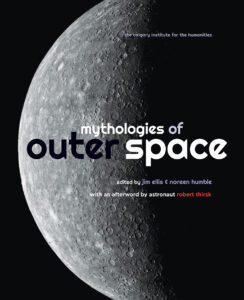
Mythologies of Outer Space
edited by Jim Ellis and Noreen Humble
University of Calgary Press (2025)
“The moon belongs to everyone – / the best things in life are free”
The opening quote of this inspired anthology sets the tone for this gorgeous coffee table book. The first thing to note is the stellar production of the physical object itself. Stunning, high quality pages, with vibrant and eye catching visuals punctuate this wide ranging contemplation of the moon. People have been gazing upward at the moon in awe and reverence since eyes could see. In this particular chapter of reverence, Dr. Jim Ellis notes, the moon “remains an astonishingly fruitful (and revealing) site for human fantasy and exploration. . . originating in the forty-second annual Community seminar for the Calgary Institute for the Humanities.” He further notes, “the contributions that follow will explore how different cultures have regarded space and celestial bodies, and how space has been imagined in art and literature.”
Multi-genre texts by a variety of experts and pontificators illuminate mythologies, science, ontologies, poems, and contemplations. In the first chapter, Alice Gorman, space archaeologist, ruminates on the ways the moon lives, as god, goddess, or man, while also reflecting on the ways the moon is mapped as a geography, or dead planet to be investigated, mined, and colonized as territory.
The idea that the moon is both living and dead fascinated my imagination, as a sort of Schrödinger’s moon. Gorman pushed me to think about new ways the moon can be considered, even after centuries of contemplation!
Noreen Humble’s essay on “Imaginary voyages to the moon: Lucian and his legacy” furthered ways in which the moon is the source of endless travel narratives. “Journey to the moon”, “the moon as halfway house during the life cycle of souls,” and, of course “Melies rocket into the moon’s right eye.” Humble illustrates the infinite capacity of human imagination to reach the destination, and such a wide array of vehicles and animal servants to get there, that once again, I was struck by the sheer breadth of commentary within. The moon is a planet and perhaps the greatest canvas for imagining. Both present and unattainable, it breeds story, hope, vibrancy, and acts as the greatest mirror to human civilization.
Dr. Hilding Nelson, an astrophysicist works on intersections of indigenous ways of knowing and traditional western science, dives into ways that the moon is part of the eco-system of the Land, colonialism. He tells the names of indigenous stars that are ever present, “Chickadee”, and Binary stars, while illustrating knowledge, and discussing the erasure of more ancient knowledge than western based textbooks contain.
Further works press into biology, science, science fiction, speculative fiction, poetry, habitation, and contemplations about outer and inner space.
At the book’s conclusion, astronaut Robert Thirsk, discusses exploration, space debris, and commercialism in space, debris, and rules that are seemingly unenforceable. There’s deep concern about stewardship. He says, “I am frustrated by misguided decision makes, and some aspects of space governance, but I have many kindred spirits who are determined to explore space safely and sustainably, and with equity and peaceful intention.” He finishes with exploration of the final frontier is too important to get wrong.”
Mythologies of Outer Space is an eclectic and wide ranging exploration, and the ways in which humanity has a relationship with space. This beautiful book will stretch your imagination and knowledge of our common friend, the moon.
Dr. Micheline Maylor is a Poet Laureate emerita of Calgary (2016-18). She was awarded the Queen’s Platinum Jubilee Award for literary contributions to Alberta in 2022. She is the senior acquisitions editor (poetry) at Frontenac House Press. She is a Walrus talker, a TEDX talker, and she a past Calgary Public Library Author in Residence (2016). Her most recent book is The Bad Wife (U of A Press 2021) won the BPAA Robert Kroetsch Award for best book of Alberta poetry and has been translated into Italian La Cattiva Moglie (iQdB).Her latest essay introduces Hunger