
By Kathryn MacDonald 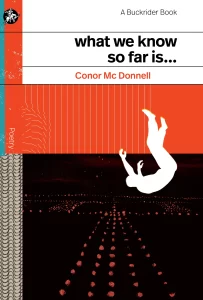
What We Know So Far Is…
by Conor Mc Donnell
Wolsak and Wynn (2025)
Conor Mc Donnell has published two poetry collections and three chapbooks and now this wild, exhilarating, and complex howl of a long poem: What We Know So Far Is….
Thirty numbered (in Roman numerals) fragments comprise the long poem. These are interspersed with 9 numbered short poems that, when read in sequence, form one long poem, which is in dialogue with the thirty longer pieces. Integral to the poetry are six pages of endnotes that provide insight into the many references and allusions Mc Donnell embeds in the poetry. This all sounds serious – and the poems are serious – but there is ample wordplay mixed with stream-of-consciousness thoughts on subjects from biology and medicine to vampire movies and musical groups that, like Mc Donnell’s writing, are experimental. Where to begin with a collection like What We Know So Far Is…?
Mc Donnell begins his endnotes with: “This book is influenced by anything and everything I have consciously/unconsciously soaked up through most if not all of my sentience to date” (87).
Following a poetic prologue in which Mc Donnell sets up the idea of dimensions, the first poem begins:
cars crash. Omagh. Wrists are slapped. Omaha.
Nothing happens not willed in a haptic universe (I, p 13).
Omagh, from Irish An Ómaigh, means the sacred, or virginal, plain, the site of the 1998 bombing in Northern Ireland during ‘The Troubles.’ Omaha is both an Indigenous People and the code name for a deadly D-Day landing during WWII. Haptic universe refers to digital sensations, simulations of touch. You can already hear the voice and see the philosophy that breathes throughout What We Know So Far Is… in the way events and ideas combine like a dream, not exactly surreal but the unconscious surfaces.
The speaker is on a quest, seeking, imagining, and reimagining. He is interested in so many things, a tumult of ideas cascading like time.
Mc Donnell describes “this flight of ideas” that run down the pages
like
throbbing skulls on stilts, like
turtles twisting over limerick’s worth of worms,
like snacking serpents shook loose and spread across fields;
the itches they scratch will weep and leak…
erupt if left undisturbed. (III, p 15)
The collection is a cornucopia of ideas and images tumbling down the pages, a torrent, but not random nor haphazard, as one might think on first reading. For example,
What We Know So Far Is
Interzone is safe haven within which to improvise:
This is why the first burial was the first act of love (XIIId, p 29)
The act of burial is symbolic, ritualistic, and it is evidence of love, an act bridging the liminal space between the living and the dead. This relates to the prologue and our introduction to dimensions, mentioned above, in which Mc Donnell writes: “Vocabulary remains mostly recognizable, but the use to which it is put cannot be understood by those who exist beyond its boundaries, nor can we calibrate current audiology to decipher what is otherwise perceived as ramblings, flights of fancy, pressure of ideas and supposed elusions” (Prologue: Nulla, p 11). Nevertheless, in this excerpt, he is suggesting that we can find what we’re seeking in the interzone.
Perhaps because Mc Donnell is a physician, there is a focus on illness, death, ghosts, and vocabulary sprinkled throughout:
… the Irish for ghost, taibhse, means show,
while taibhseach means showy or spectacular,
and taibhsim means I appear.Tabhsim taibhse taibhseach,
I appear as spectacular showbut also I appear as showy ghost.
Words worm there way in …
We screw things up to an uneasy peace,
fill it with missed opportunities (XIV, p 31).
XXI, a long portion, begins: “I pray for magic, and pull at invisible switches” where the “cell is dungeon and everything,” where [I]
… ferry them through surgeries wipe memories
clean, then pull their spirits back through most miraculous
recovery: let them redock themselves. So long since
I lost perspective on death after years of smelling
it on your breaths, the linens and robes your loved
ones wrap you in before they brave home. Only then
do angel wing and furies beat. Your time is come and
I am sorry that you’re stuck with me but I put down
my drugs, unplug the electricity […][…]
… or maybe the truth I’m fighting is that when I
wrote I will be there when you die, it might not just
have been for my wife but for some stranger’s as yet
unborn child, and when that nightmare lands on
me, I will be better there for you, not pausing the world so
I can sleep too: what we know so far is another world (p 49)
Internal conflict. On the page a teasing out. Isn’t this why we write poetry? Isn’t this why we read poetry?
All of this aside, What We Know So Far Is … abounds with wonderful wordplay and riffs on language. My favourite takes me obliquely into Alice in Wonderland, a surprise: “Take the Hatter’s t away, a thirsty Hater takes his place” (XXIX, p 77). Another example:
Murmuration unleashed by the throng, prays high in beams above:
swoops and swoons over sacristy, lording over the gathering beneath,
deftly sculpting angle of descent
anger of dissent
angst of decency
angelic deception on auto-repent (IV, p 16).
The Arabic numerals that identify a separate, but integral, long poem create a second voice, one that is more, what? Personal is not quite right. They shift the tone and are less stream of consciousness. Taken together, they create what Jane Hirshfield calls an Assay, a poetic essay on a theme. In this series of poems is some of Mc Donnell’s most beautiful writing:
when we were unmade, we were scrutinized
to death. when we were unmade we were
words of and for wolves. we were unmade
to churn out the latest millennium (7, p 57).
Still, in the final Arabic numbered piece, we remain “unmade,” our situation “unresolved:”
9
so far, what we are sorry for is unresolved
despite the pause despite Deepwater Valdez
despite Port of Beirut despite so many
generations unmade with a word and even
though the oirish have no word for no even
though the plural of word is sword and will be
for millennia at this rate of mutation-
imitation those born to only sleep forever
are worn for weeks in swaddling hems
until we reach the triptych sea sky &
beach, sat still in perfect shirtless circles,
and unstitch sleep from skin, set loose
the bloodlust of a thousand piercings
9
On one level, one can read this collection and pleasure in the music, in the words, allusions and images. But if we do that, what we might miss is the howl (think Allen Ginsberg). What We Know So Far Is … a cry for our time, a cry for us lost in a haptic world.
Kathryn MacDonald is the author of Far Side of the Shadow Moon and A Breeze You Whisper. Learn more about her work at kathrynmacdonald.com