
By Kathryn MacDonald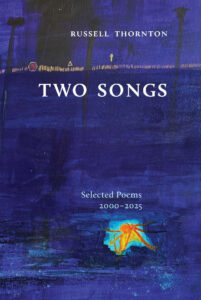
Two Songs: Selected Poems 2000-2025
by Russell Thornton
Harbour Publishing (2026)
With nine previous collections, Russell Thornton is a poet whose name you will recognize. You may have one or two of his books on your poetry shelf, but don’t assume there’s nothing to be gained from diving into Two Songs. The selected poems not only echo across time and situations, they remain fresh, relevant, and beautifully satisfying to read. A great advantage in reading this collection over twenty-five years is that you will see the consistency and the development of one of Canada’s foremost poets.
The poems in Two Songs are collected chronologically in nine sections, each containing poems chosen from individual books, plus a final section: “Uncollected and New Poems” (223-238). Thornton takes us on a journey through life, with poems focussing on childhood and parental relations, parenthood and his own children, love and violence, his home on the West Coast and his travels abroad. The collection is far-ranging in topics, themes, and place. Across this wide spectrum, Thornton’s voice sings with lyricism, boldness, and energy. From the first poem, I was engaged and enchanted, torn open and somehow soothed.
Night Tide
I stood where a tide began rushing to fullness,
drawing out long grass as it wove through sand dunes,
then walked east …
…
suddenly aware I was no longer what I had been.
This awareness, this transformation, is emblematic. The poem continues with vivid imagery until we reach the turn:
Then an old woman was at an open door.
We’re all leaving, she said. I know, I’ll be ready, I told her.
You won’t be able to keep her a secret anymore,
will you? she said. While I watched her turn and go,
I felt the one she had spoken of showing through my face.
Writing through the “dream dark,” he takes us into a space literal and magical, lays physical reality alongside the mind’s reality.
The first two poems in the collection take my breath away; they are ripe, sensuous, and layered. I cannot stop underlining, scribbling in the margins, and turning pages, until I finish the section and come up for air. I am drawn in and held by the way Thornton weaves images and metaphor, how he builds the poems with words and images that circle and repeat, search and take the reader deep inside experience and all it offers. For example, in “Creek Trout” (13), he first describes the trout then moves into metaphor:
To see the trout, to gaze after it
as the doors of the water open before it,as the innumerable chambers of the creek open before it,
each a new exultation, a new feeling of the tough of the creek,a new entering and entering,
…
Already, in 2000, Thornton is an accomplished poet. Reading “Morning on Wickaninnish Beach” (15), I was struck with the alliteration of “w” and the sound of it running through: “wire, walk, marrow, wheeling whiteness of a wave”, through to “world” and “word”. Many aspects of the craft of poetry can be found subtly woven into the work, alliteration is one, metaphor is another.
Throughout the collection, words are held, repeated in such a way that they connect and enlarge thought. Thornton creates a scene, as he does in “The Beginning of Stars” (second section, Tunisian Notebook, 2002, 21-22): “The late sun burning close and slow waves coming in – / the sea’s mysterious lit wine of touch…” and few lines below, “grapes / spreading throughout the night’s summer vineyard.” Farther along: “The body is the wine-flask and the wine: / the lover is the veil on the beloved’s face.” This is simply gorgeous writing. Thornton works an image—turns it inside out.
Jumping past the poems selected from House Built of Rain and The Human Shore, there is a space of seven years before Birds, Metals, Stones & Rain (2013) is released, and while the 2003 and 2006 collections continue the delicious poetry, I see a shift occurring with poems in the 2013 selection. Here, the writing echoes back to poems selected from The Fifth Window (2000) from which I first quoted, but there’s been a change in style. Where previously, I noted how he expands on a word like wine, here he begins doing something different, more imaginative, repeating and repeating with amazing effect. In “Burrard Inlet Ships” (77-78), he repeats “As if…” ten times and “All night…” three times. “They’re always there” stands out on the third line and is repeated on the final line. These repetitions create music, a beat, sonorous, demanding. Another example, “Nest of the Swan’s Bones” (70-80) begins with an epigraph and a dedication, and continues:
High in the blue air above the dumpster in the back lane,
between the mountains and the tidal flats,
on the thermals and updrafts a summer hawk does slow turns.The crows pick at the waste on the asphalt.
The men push jingling shopping carts. Or stand and mimic life
in prison year. The wild white swan is dead. Where I caughttrout as a child, no trout swim now. The drives
and crescents gouge ravines, make creeks disappear. Where wild
baby fish run, they run the gauntlet of penned fish. They are eaten alive,their eyes popping out as sea lice feed inside their heads.
The hawk dances. Circles, dances. Its shadow flits
unnoticed across men, spreads over a rodent or bird//
…The hawk hunts and kills the swan for love. It will build a new
nest of the swan’s bones. It will keep this nest unseen.
I am a person. I soil the cage in which my heart flings
and flings itself against the bars. I try to ownthe view of every murderer, and yet I try to sing
the way out through the hawk’s claw holes to the repose
in the nest of fire at the tip of the hawk’s wing.
A new rawness enters the poems in the fifth section. They powerfully witness both the situation of people and of the environment. They follow an observation, a word, a thought, enlarging and enlarging, employing an echo strategy, until the poem is resolved and the reader left breathless and satiated.
Some of my favourite poems in the collections are in this section, poems of Thornton’s son and daughter as children, such as “River Rainbow” (87) and “My Daughter and the Seagull’s Cry (90-91). These are mixed in with heartbreaking poems such as “Aluminum Beds” (88-89) about his own childhood.
I am fascinated by the way Russell Thornton weaves stark reality with dream. It is something we see as we read through the collection. The first poem, when we opened the book, began that way. The first poem selected from the sixth book, The Hundred Lives (2014), continues blending the two realities of our lives: the everyday and the dream. There’s another thread that runs through Thornton’s writing that has become obvious and that is something secret, recognized but elusive. All three come together in the sonnet,
Pitcher
Entering her parents’ house in secret,
finding a pitcher of ancient design
sitting on a plain wooden shelf. Knowing
that moment in the dream that she has died
and time has passed. No one having told me.
Then going with the pitcher in my hands
out into the vague street. Great energy
beginning to flow through me. The smooth loop
of the small handle. The quick curve and gleam
to the base. The soft plummet at the mouth.
The dark space within will urge me on now
and I will see that it is desire vast
and wild as death, and it hid here before
it came to break me, and is filled with her.
These poems haunt me with their immediacy, their authenticity, their narrative flow. But it is their craft that makes them poems to study, to reflect upon.
The poems grow and deepen. In The Broken Face (2018), the seventh section of Two Songs, in the long poem “The Wound” (147- 150), Thornton links Greek myth, Shakespeare’s soliloquies, and Keat’s odes to the stories of Skaay the Haida. In “The Wound,” Thornton names the space between the everyday and dream, as he explores “the boundary between worlds” and the reader knows we are experiencing mythic truth:
The opening, closing, opening wound, breaking, stitched, breaking—
is love freed again and again from anything that binds it.The love in the surface bird, the desire in it for the other shore,
the other shore that has no shore—
is the hunger of a gull trying to flap wings oil-slicked or trapped in coils,
and the waves circle and the surface bird cannot lift itself from the sand.
From Answer to Blue (2021), I want to mention two poems: “Great with Tigers” (173-74) and its first line that surprised me: “The smell of menstruation moves…” and “When the Whales Return” (175), with the line “… a girl carrying a tiny heartbeat / that had joined her own in the space she discovered inside her …”. He manages to combine the orcas’ return, “the first time in eighty years” with the intimacy of the poet in his mother’s womb. These poems feel like little miracles, so accomplished we can read them without noticing the skill woven through.
The final section of Selected and New Poems continues the subjects of family and images of the environment, of birds and sea, people but always the poet is engaged, seeking. In “The Missing Letter” (227-228) we find “memory’s measureless line of sight restored.” The puzzling mysteries Thornton struggles to uncover are never quite revealed: “One morning, you are given a glance at your entire life” (One Morning, 233), but it is a mere glance. Lights continue to flicker “on the verge of an abyss”, “Decorum” (232). The questions that drive the poet continue.
Two Songs: Selected Poems 2000-2025 came highly recommended, but I was leery of such high praise. Reading over my notes and claims in this review, you may wonder if the book is that good. It is. I can read a poem and love the story, admire the idea, thrill at the imagery. Russell Thornton’s poems give the reader these things and more. These are poems to read and enjoy, and they are poems to ponder – their intellect, passion, authenticity.
Kathryn MacDonald is the author of The Blue Gate (Frontenac House, 2026) and four other poetry collections. Learn more about her work at kathrynmacdonald.com