By Catherine Owen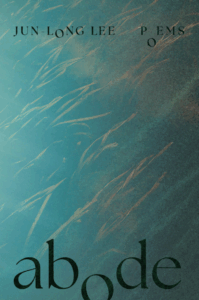
Abode
by Jun-long Lee
Athabasca University Press (2025)
A gorgeously-designed pocket book of mostly prose poems, all untitled, in a surrealist vein, Abode takes the reader on a Bachelard-style sojourn into the “crouching shadows,” “half-naked nave” and “haunted structures” of abstract and meandering dwellings. Jun Long Lee’s voice is a cold probe within unheimlich realms. “The length of me lived in two places,” he announces, both overtly and as a trace of the diasporic discombobulation one witnesses as a reader. You are not invited into these pieces. The narrator feels nebulous, shifty. Settling is an ineffable aim. Expectations are overturned relentlessly. The room “has no roof,” belongings are left “in the grass” to decompose, or they are “transparent,” people become “cisterns” or animals, the houses are not yet present or eroding or are constructed with inconceivable plans where “doorways” turn to “arks.”
Abode is divided into eight sections, though distinctions between each are often murky, apart from the opening and closing parts, titled respectively, “A Way In” and “A Way Out.” In between, there are ruins, greenhouses, cathedrals, animals, builders, drowning and caves but all these subjects and actions converge, converse. The narrator’s consciousness is one that examines in an essential haze, recollects from a distance, realizes that time changes little in the psyche while the “deterioration gathers witnesses.” The attention to detail involves a plethora of slippages and thus the total environment of the text is one of estrangement, even in intimacy.
The prose pieces are occasionally paired by a tripping lyric, designed to draw out detail: “Bloodferns turn/deep into the soil/with slept-on fronds:/wrongs, meats,/other beings/regal and crouched –” though mainly they compel a changed relationship with sound, and particularly the ghost-howls of assonance. In the prose poems, the eye attempts to enter images, is thwarted or a mere crack opens, then the lyric elaborates a tangled music that seems to accompany this quest, whose climax of yes will usually be repelled. Jun Long Lee, in the manner of Paul Celan, inserts a range of port manteau words into his poems, a smashing together of the atoms of sound and sense: “saintlylimb,” “hourhollow,” “allpast,” “organsmoke,” “halfbelonging,” “nothingshaped.” Such a surging fusion impedes our capacity to effect and retain boundaries, and so the house of meaning in our minds is regularly compromised. As with the poems of Chika Sagawa, the poems in Abode allow the reader to choose their own path. Either they relent to the incomprehension and then the pieces become fragments of a magic or they spurn their endlessly impenetrable surfaces or their over-penetrated slitherings of imagery and so cast any possible epiphany out.
Catherine Owen, a Vancouveriteedmontonian, has published 17 books in four genres. Her latest is Moving to Delilah (Freehand Books 2024), nominated for both the Al and Eurithe poetry prize and the Robert Kroetsch award. She teaches Poetic Forms at Concordia University of Edmonton, runs The Clio Project, a documentary series on older women artists, and edits and reviews from her 1905 home on Alberta Avenue.