
Reviewed by Kim Fahner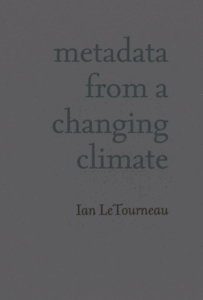
Metadata from a Changing Climate
by Ian LeTourneau
Gaspereau Press (2025)
Reading Ian LeTourneau’s new collection Metadata from a Changing Climate reminds me of the C.S. Lewis idea that we grieve only as deeply as we love. Grief hits harder when someone values, respects, and loves a landscape, person, pet, or even a way of life. To take note of change, in and of itself, is something that requires close attention—something most poets are good at. The act of collecting metadata suggests close and careful scientific observation, and a notation and recording of changes in landscape, or even in a person’s life. There’s a keen awareness of how time and history work, and a recognition of the importance of place. As he writes of place, LeTourneau is mindful of his role as a settler, and how that history influences his view of place as he writes of New Brunswick.
Considering history, for instance, in “Reversing Falls/Rapids,” the poet compares a trench that Sassoon might have seen in war to the Saint John River at low tide…
full
of bereavement, a blindfold sweeping
across the valley, a freepouring
of millennia, its Styrofoam vernacular,
cut short by the Atlantic.
That initial reference to loss is one that carries through LeTourneau’s poems, but he offers the reader an invitation to look even more closely. In “Sea Urchin,” the speaker refers to the shell of the sea urchin as something that “transports the viewer / into the depths of a whole ecosystem.” In the smallest things, we can see the universal.
Climate change is referred to repeatedly in this book of poems. In “Porcupine Nocturne,” for example, the poet notices that the porcupine has.
You’ve lost some swagger
since infiltrating the suburbs, streets
of urban sprawl pre-packagedwith familiar formulae –
With the expansion of human spaces into natural ones, habitats are lost and need to be re-imagined by various creatures who were there first. “Migration” alludes to the flight paths of Monarch butterflies, how “Migration is more than repeating ourselves. / Transformation is taking place.” More intense floods and storms make themselves known in Metadata from a Changing Climate, suggesting that the changes in weather will ultimately affect the health of the natural world and its various creatures.
In highlighting the beauty of big ideas like landscape and history, the poet depicts the detail of everyday things that tend to be taken for granted. In “An Incomplete Biography of My Hands,” LeTourneau documents the life of his hands, writing that they are “tenderized by vibrations of lawnmower, / jolted and stung by connecting bat with baseball…placed on my grandmother’s cold hands at her wake, placed on Chaucer’s tomb in Westminster Abbey.” He speaks of his hands’ humanity, “bursting beyond their workmanlike lives, fully inhabiting their animal purpose.” He writes of climate change in “The Sound Before the Post-Tropical Storm,” mentioning that “The storm itself / might not make a sound, or the drumming / of the rain will set a new baseline.” In both poems, LeTourneau connects the mortality of humans to that of the planet, highlighting the idea that time shifts and changes, affecting humans and the environment.
Poems like “Hardened Evergreen Habitue,” an in memoriam to Les Murray, is written from Elizabeth Bishop’s childhood home, and “Great Village Antiques,” speak to how artifacts of the past—from salt and pepper shakers to stuffed and porcelain birds—echo the essence of many human lives that have passed from here to there. In “August 10, 2018,” loss is present again in a raw way when LeTourneau writes of the mass shooting that took place that morning in Fredericton: “Weeks later, our hearts remain / at half-mast in grief.” To deny loss is to devalue life in all its sorrow and beauty. LeTourneau asks his readers to consider that balance, to think of how both aspects dance together.
Kim Fahner lives and writes in Sudbury, Ontario, Canada. She has published two chapbooks, You Must Imagine the Cold Here (Scrivener, 1997) and Fault Lines and Shatter Cones (Emergency Flash Mob Press, 2023), as well as five full books of poetry, including: braille on water (Penumbra Press, 2001), The Narcoleptic Madonna (Penumbra Press, 2012), Some Other Sky (Black Moss Press, 2017), These Wings (Pedlar Press, 2019), and Emptying the Ocean (Frontenac House, 2022). Her sixth poetry collection, The Pollination Field (Turnstone Press), will be published in Spring 2025. Learn more about her work at www.kimfahner.com.