
By Vivian Hansen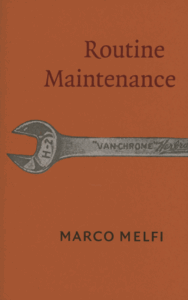
Routine Maintenance
by Marco Melfi
Gaspereau Press (2025)
Marco Melfi’s debut poetry collection, Routine Maintenance, brings the routine into play as observance – a significant meditation on the mundane and its sacred positioning. Melfi could be seen as poetic DNA that rolls back into the Montreal Italian poets of the 1960s, including his own father, and Fr. Pier di Cicco. Spiritual Catholicism imbues the work in some soothing passages, and draws this reader into a profound realignment of what constitutes poetic craft.
‘Saturday at the Eco Station’ lines a piled visual of what we discard, in one roll-on poem, 27 lines of imagery about garbage that I find strangely endearing:
Pickup trucks sparkle like parade floats.
Their tailgates display the spoils of spring
chores: armless Pöangs, rolled rugs,
and paint cans from the aughts. Trailers,
teeming with spruce and hawthorne branches,
exhibit a range of pyre shapes. (39)
Alliteration reinforces the sense of repetitive discard; even renewal and resurrected visions of beauty. In “Birthday Balloon”, we envision a sleepy amusement on the morning after the night before:
It napped most of Saturday face up
against the living room ceiling.
Tossed and turned whenever
the air conditioner coughed.
I wished I could sleep in too.
As I lounged, it found its bounce
and shuffled around the house.
It made out with the door jams,
gossiped with the walls and even
goaded the cacti on the credenza.
I enjoyed its tinselled patter (30)
Internal rhymes suggest a balloon who is quite the party animal.
Observance overtakes the more passive observation in this collection. It holds some prime places where Melfi looks behind, under, above, and finds a place to land the eye. In ‘Nostalgic Alleys’, you want to find the rhubarb; the treasure behind the tire:
A Sunfire waits, as if its driver forgot their wallet
and popped home for a moment that’s turned into two
decades. Rhubarb has sprouted around its tires. (72)
Melfi’s craft is edgy and unpredictable; the promise of a couplet delivers no anticipated rhyme. A line break and enjambment lays out a strategy, hunting for meaning. The two-or three-line stanza becomes a presence of absence; the observance of craft defies adherence. These strategies allow for a considered homily in the presence of vision. In “Cobbler”, the scene arrests a presumed aesthetic:
An old soul, he waves
in walk-in after walk-in. His bravado—Unthreading leather like he’s tearing paper–
is coupled with tenderness:handling, in scuffed hands, sandals
like they’re an injured appendage.Exhausted by the stack he has to fix
I hope he hides an attic of elves. (26)
Personification hits a breathless stride in many of these poems. The ubiquitous alarm clock assumes the first-person POV: “I’m free to belt out a tune/and serenade the houseplants for days.” (55)
Poetry as observance is sort of like good hygiene. Melfi takes the lyrical voice to fine and pleasing locations.
Vivian Hansen is a Calgary poet and writer.