
By Vivian Hansen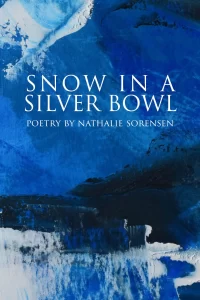
Snow In A Silver Bowl
by Nathalie Sorensen
Frontenac House (2026)
Sometimes I crave reading the presence, of a collection of words that affirm my era. Sometimes I don’t want to lick my finger to turn the page; I know it will turn without the effort of what is wet. Nathalie Sorensen’s debut collection is one such poetry book that keeps me turning in resistance to all things that are inaccessible to me.
Even so, the wet enters the motion of turning: “this is the river, ravishing,/unknowable, itself.” (14) These poems are the river, the essence of a self that craves affirmation in the lucid, hard dreams of a life. Sorensen uses this word at a frequency I find intriguing, “… a lucid blade of grass,”(15). What is lucid, after all, but a waving handkerchief, a sometime sorrow that reminds us of what we cannot stash aside.
And then come the images. These are holy in their poetic magnification: the numinous hallucinations that heal (20) where the lion sits down with a carried Caro (a friend dying of cancer). Perhaps the most poignant parable is found in “when an old fireplace/is lit again, the old people come back.” (23) This place is the ‘rest hard’ industry of memoir and how one creates space for the healing.
The structure of many of these poems is asserted in commas, which infiltrate so many lines but also emulate a kind of recipe and second person solution:
Look up.
Stars, nebulae, quasars
galaxies, supernovae;
a small part of all there is (35)For weeks, months, years
make ink. Grind the inkstick
in the shallow stone bowl
until your arm aches,
until the ink is impeccable,
a true dark. (35)
This is the measure of years for a woman, but like the early feminist confessional poetry, the poet grows a tantalizing close watch in the magic realism of the laundry. It is that horse rising from the aquarium that we always suspected was there, but never really sure.
From The Unicorn in Captivity (Unicorn Tapestries, 1495-1505, MET Museum)
He bleeds.
Drops, red as berries,
Spot his white coat.
Around him, flowers, bluebells,
oxlip, bistort, cuckoopint,
woven with botanical care,
tinted with madder, turmeric, woad.Who among us will breach the fence,
unbuckle his harness,
help him to his feet,
and lead him into the bluebells?
The question of who among us seems not to have changed in more than 500 years, and this is an unsettling apprehension of how the human voice just cannot catch, a moral force.
Lest the modern reader of feminist text dismiss this simple knowing, Sorensen offers another guidance: Lascaux, where she last lay in the grass, a woman comprehends: “deep in the grass, the aurochs pass.” (30) The extinction of a hunted creature is uncertain, but we can lay here for awhile and think on it.
I experience a fine gratification in reading this work; it is an accessible and sensate offering. It does all the heavy lifting and allows me the rest.
Vivian Hansen’s publications include three full-length books of poetry — including A Tincture of Sunlight and A Bitter Mood of Clouds — and several chapbooks. She has published essays in Coming Here, Being Here, and in Waiting. She also has a short piece in the Calgary Public Library Dispenser Series (2019) Where We Surfaced.