
By Vivian Hansen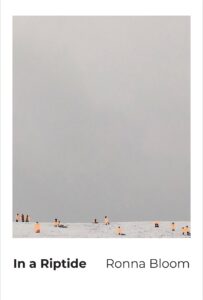
In A Riptide
by Ronna Bloom
Brick Books (2025)
Lolograssing: What Means This?
Ronna Bloom’s exploration into death is an honour; as though we must all come late to the explication of words that are used to touch death. Four intentions of dying come to close meanings of how we all come near to such closure: To Show the Scars: Sick Person, For Ten Billion Years: Old Person, The Earth Held Me: dead person, Don’t Close the Door to the Door: Happy Person With Nothing. This collection works on the essential journey of dying to the self.
In the first sequence, we come to terms with the hospital setting; the sickness of defeat. It is a place of trauma always newly visited. Here, we must encounter the difference between healing and sending, in a setting that always delivers a site of unassailable conflict. This is where we can all discover a found poem:
Lyrical Hospital
Who is your mercy contact? (10)
Look for them; the words will comfort. Or not. The poet only promises that you can read in short, manageable bursts when you are in crisis. Or perhaps that perception is just crutch-like enough to buy you some time to feel.
We put our heads down and try to work
our tiny magics.Take our blessing pills, interrogate our crimes,
and commit new ones. (16)
More than likely, the uncertainty and warnings of sickness must be assuaged in how we become hollowed out to God:
Out of this, let my small noun cry faith.
Let me unperson for a minute –
here, hold my cup.
Breathe me presence into the face
of my mother’s tantrum of grief
that I can’t answer any other way.
Her whine – let it be a song-plea
to the balladeers of other centuries.
O, how the cows moo in solace. … (20)
O, how the O has it. We hear the grief.
In the second movement of the collection, the old person laughs:
Sisyphus
Carry your own stone. (28)
I wish I had presented that stone to conflicted friends and critics over the years. There is a kind of grief with it, like time and energy wasted in the sense of obligation to roll that stupid, wretched stone upward in the illusion that we make all the difference. Was that sentence long enough? Bloom makes it easy, and I see the small poem as stone.
Bloom envisions a scene, in Rending the Garments: “There should be a shiva for every kind of grief-/the break-up, the diagnosis, the assault-/where people come over unbidden and/wash their hands and bring casseroles/and hold you. (43)
We are getting closer to the keening, and the reflections of grief. All is not a depth charge, though. Bloom leaves us with the magnitude of analogy. How we slip through the invisible barriers between life, death, grief and healthy contentment:
Death leaves you so alone.
Your hand goes through a mime’s window
Hello? Anybody there? (56)
I’ve always enjoyed the faith of a mime. Bloom’s collection offers us that hope.
Vivian Hansen’s publications include three full-length books of poetry and several chapbooks. She has published essays in Coming Here, Being Here, and in Waiting. She also has a short piece in the Calgary Public Library Dispenser Series (2019) “Where We Surfaced.” Her most recent work, “A Bitter Mood of Clouds,” is available from Frontenac House.