By Catherine Owen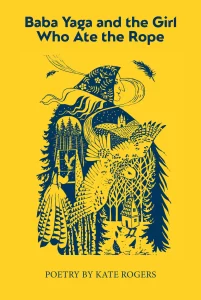
Baba Yaga and the Girl Who Ate the Rope
by Kate Rogers
Frontenac House (2026)
When I was young, fairy and folk tales were one of the genres first read to me, then listened to on vinyl and finally delved into myself in a book of Russian stories I absorbed on long rainy days in Vancouver. Baba Yaga is a dualistic witch character from Slavic lore, who can both be a hideously nasty child-devouring cannibal and a helpful old lady who lives in a hut that swivels on chicken legs surrounded by a bone fence. Her moral ambiguity, her ability to fly in a mortar and pestle, and her representation of the dangerous wisdoms of nature all made her compelling to me.
Kate Rogers’s debut collection of poems (with its striking linotype on yellow stock) honours the improbable interpretability of this character as she comes to represent her own Ukrainian mother, during her struggles with dementia. It’s a challenge to write about one’s dying parents, the content ubiquitous, difficult to render originally. But recently, Bren Simmers’ did so with elided vowels to represent her mother’s increasing aphasia in The Work and Roger’s has done so in Baba Yaga and the Girl who Ate the Rope by palimpsesting myth onto the stark realities of mental diminutions.
A daughter’s relationship with her mother is often ambivalent. Even when close, there is still a need to detach (or eat the rope). Rogers’ use of Baba Yaga as her mother’s doppelganger (also her mother’s acknowledged nickname) in the book’s first section emphasizes this push-pull feel of the bond, especially when the daughter is left to care for a mother who often can’t even recognize her, who verbally abuses her or rejects her nurturance. In “Baba Yaga’s Child” details anchor the continued connection between them, despite the constant losses:
In my pack, tins of alphabet soup.
Inside I pour two into the dented pot.
Baba Yaga smooths open the Scrabble board’s
broken spine on her cherry table,
picks seven tiles
from her black bag of charms.
At first, she remains in her forest house, still feeding the birds through cataract surgery and knee replacements, but after covid, she ends up at a care home, her mind failing. In one startling piece, Rogers returns to the house to look “In Baba Yaga’s Closet” for a coat and in a silk robe finds projected secrets, then recollects the horrifying moment when she was a teenager and her mother, “dropped [her] towel/kicked [her] leg in the air./Declared:/ “This is what a used crotch looks like!” (this scenario is so very opposite to anything I can imagine my own mother doing – I am still in shock ;).
One of the most beautiful poems is “Baba Yaga’s Garden,” both for its sweet imagery and for the way it is carved into solid quatrains, effecting a more formal accuracy than many of the random-stanzaic pieces in the book.
The second part includes three Baba Yaga poems (the most powerful her spell against wildfires with its triadic stanzas of dance and wail) but mostly focuses on human-created despoliations of the Canadian environment. The longer couplet-structure of “False Spring” is particularly compelling with its attention to assonance and disjuncture:
Beach sheathed
in ice. I shuffle the shore. A slumped
starling rides the rolling frazil. No:
a single black glove.
Or “Winter Temperatures Wake Bears Early” with resonant lines like: “She saw it in her naked orchard following the ghost scent of apples” and “Out my window, ice shrinks from the lakeshore, rictus grin.” Or the heart-slaying “Letter to the Hunter at Hay Lake” that begins “What’s it like to live without/wonder.”
The final section is only four poems for her distant father (then a somewhat insular epistle to her stepdaughter for an Outro) and it feels like a quick surface scratch, though perhaps that is the point, one can go no deeper into a man who never said the name of his teen sister after she died, whose life’s “sap barely flows to [his] heart.” These last pieces possibly belong in another book however, as the core here is Baba Yaga the mother and her forested home and how, beyond all quirks or failings, she seems to have instilled in her daughter a deep love for nature. Baba Yaga and the Girl who Ate the Rope is a memorable plumbing of myth enacted to more poignantly voice the real.
Catherine Owen, a Vancouveriteedmontonian, has published 17 books in four genres. Her latest is Moving to Delilah (Freehand Books 2024), nominated for both the Al and Eurithe poetry prize and the Robert Kroetsch award. She teaches Poetic Forms at Concordia University of Edmonton, runs The Clio Project, a documentary series on older women artists, and edits and reviews from her 1905 home on Alberta Avenue.