
By Frances Boyle 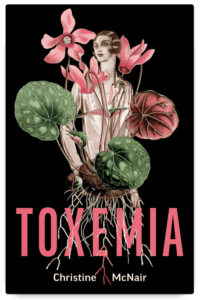
Toxemia
by Christine McNair
Book*Hug (2024)
Toxemia, the first work of creative non-fiction by multiple-award-winning poet Christine McNair, is a powerful and emotive collection of lyric essays that tracks McNair’s several horrifying experience with illness and injury. “Toxemia” is the historic term for what is now called preeclampsia, a hypertensive disorder of pregnancy which is life-threatening and significantly increases the risk of subsequent stroke and heart conditions. McNair suffered with preeclampsia with each of her two pregnancies, notwithstanding clinicians’ assurances that having a second episode would be highly unusual. The book seems part of a continued effort to contextualize these experiences and “to contain my fear and put a circle around this work.” (150).
Skillfully constructed, evocative and compelling, Toxemia is far from a static chronological recounting of illness and its impacts. McNair guides the reader through layers upon layers of incidents and reflections. “My mother peels layers of my skin away with the washcloth” (95). McNair says, and she herself peels back layers of personal and familial history. Another compelling metaphor is that of nesting doll(s), which McNair uses as the titles of two of the essays. Memories of a childhood accident live within the joys and terrors of giving birth and fearing death, nested among stories of her forebears, both real and cobbled together or fleshed out from scant and perhaps inaccurate information. “I introduced a ghost memory to the fold” (155) she muses, but concludes that nonetheless “a sliver of something like a person … is something of a person.” (156).
McNair brings us intimately into other health crises besides preeclampsia, including stroke and heart issues, sharing the visceral impact of symptoms and fears prior to a rare heart condition, marantic endocarditis, being diagnosed: “I am not having a heart attack. It is my asthma. It is anxiety. It is indigestion. It is my heart. It is my lungs. It is my brain. It is the fae. It is excess of mercury. It is a familial curse. It is a small elephant curled onto my breast bone. What is it.” (51) and the moving lines “Please let there be something that can be found and treated… It just has to stop. I’m drowning in the unexplained.” (53). Anxiety and mental health challenges are also revealed as life-threatening, with eating disorders, clinical depression and a suicide attempt among the layers and intersecting elements of McNair’s medical experiences
McNair uses a variety of devices that amplify the impact of her themes. Some essays are very brief, while others unfurl in numerous sections. With a few exceptions, McNair uses present tense, bringing urgency and immediacy to the medical events. Some essays probe French grammatical tenses, with titles such as “imparfait” and “passé composé”, and the terms’ explanations (in English) as epigraphs. This adds to the nested, time-shifting feel – the difference between repeated past actions is blurred into fears of what might happen. Other titles play upon the notion of déjà vu: “déjà vécu”, “presque vu”, “jamais vu”, “déjà vu” (for two poems), “déjà rêvé’ and “déjà entendu”.
“foliate” employs a technique McNair used for the poem “the problem with orchids” in Charm, her Archibald Lampman Award-winning poetry collection: strategic replacement of key words in an official text (here a 1916 “mother and child” guide) to surreal and occasionally chilling effect. She writes of the “flower pressure” of “explosives” during their “latency”, of one explosive who “went into the defoliating room and gave mirth to a perfectly normal changeling”, of “roses and irises” and “sluggish owls” (71-74).
The essays “jamais vu” and “déjà vu” are shaped from text from Downton Abbey where the fictional Lady Sybil’s death exemplifies the historical frequency of maternal death when preeclampsia could not be halted. Other cultural references ground the experiences in the quotidian, while elements such as historic texts, a comparative table of symptoms, and a listing of treatments over time add context without pulling focus from the personal and immediate.
Visual images are effectively interspersed throughout Toxemia. Two photos are especially moving despite their simplicity. In one, McNair’s grandmother’s hands are loosely clasped atop folds of fabric on her lap, and in another tiny children’s clothes belonging to McNair’s two young daughters are displayed as in a museum exhibit. The latter photo is situated within the longer “Nesting Dolls” essay, one section of which enumerates questions to be answered “based on research about what people want to hear from their parents who die too soon.” (100). In an earlier section of this essay, McNair worries “If I die now, my children will barely know me… They’ll remember me in stories that other people tell them until those become their memories of me… They’ll remember cut-outs of who I was” (99).
The book’s sections headings echo stages of medical diagnoses: “symptoms”, “presentation” “risk factors” and “treatment”. The progression through these stages is subtle and nuanced, with the intersecting memories culminating near the end of the “treatment” section with McNair’s hope that she will leave “some sort of glow record for the kids. I want a touchstone for me of time and good for when things go dark.” (157).
McNair writes that “every body survives something. Or they don’t.” (145) and that “The body remembers what the brain forgot.” (67). Toxemia is an impressive and deeply moving evocation of survival, and of remembering.
Frances Boyle is the prairie-raised, Ottawa-based author of three poetry collections, a Rapunzel-infused novella and an award-winning short story collection. Her debut novel, Skin Hunger, is forthcoming with Guernica Editions in fall 2026. For more, visit www.francesboyle.com.