By Kathryn McDonald
Long Exposure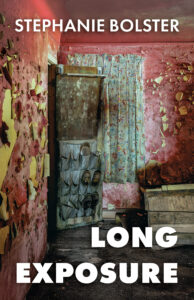
by Stephanie Bolster
Palimpsest Press (2025)
Long Exposure is Stephanie Bolster’s fifth and most recent poetry collection. Readers may know Bolster’s writing from her Governor General’s Award winning The Alice Poems, her first book (1998) through to her fourth, A Page from the Wonders of Life on Earth (2012). After Wonders, she noted in an online interview with Poetry in Voice, that “increasingly I feel that the best poetry arises from some social calling, or fulfills some social need.” Long Exposure does just that.
The collection opens with the words, “It is not something that begins.” Following about a 10-line white space giving readers time to consider, then continues:
Before there was land there was water.
A place silted itself up.
Around the time of the pyramids
parts of other places made this place.
and, so, we are introduced to Long Exposure and to New Orleans, a key place for the unfolding of Bolster’s theme.
“What began in 2009,” Bolster writes in the acknowledgements, “as an interrogation of my unsettling fascination with Robert Polidori’s photographs of post-Katrina New Orleans became an education that has lasted for 16 years and does not end here.” As Bolster probes Polidori’s images, she notes how the hurricane’s destruction was multiplied many times over by failure of the unmaintained levies. And she resurrects other disasters: Chernobyl and the nuclear meltdown of 1986, the Interment of Japanese-Canadians in B.C. during WWII, Mothers of the Disappeared in Mexico. She exposes a litany of social atrocities in the compelling and extraordinarily-crafted singular poem, Long Exposure.
Bolster’s collection is a kind of rabbit hole, a warren of man-made disasters. She tells us:
Sometimes to look
is merciful, sometimes
to turn away. (32)
The poetic images are, themselves, horrific. In “Shelter Object,” she introduces the first of the Chernobyl poems:
The constellations made of fear. Chaos
where a shape was. Stars where a roof.A fire where a place. The world
asleep in its bed. World irrevocable.The heat unfathomable. They worked
shirtless. Already acute in hospital.Soon coffins of zinc. Soon
they’d gut the wards of the dead.
The writing builds to a crescendo. Following 17 couplets, the tone and pace shift, slow to conversational speed:
His mother asked when the bus was coming and in a while
she asked and again and then didn’t and
he turned she was dead.
He covered her there in her wheelchair outside the Convention Centre.
Put a note on her. Came back
four days later she was still there.
The bus came for him. She was still there in her chair
bus was leaving he wanted to go to her National Guard said
You’re just going to get on the bus. You must be on the bus.
The bus took him to another city.
Bolster controls the pace using her poetic skills honed during her previous award-winning writing. Her language remains controlled, yet she draws us in, hold us, hold up the horror. (17-19)
Beside the poetry, in small type against the righthand margin, are facts and numbers should anyone imagine exaggerations in the poetry. In order to credit her sources, Bolster includes the names of the journalists and their publications at the end of the book, requiring more than three pages of dense type.
Depending on her subject, Bolster shifts techniques. For example, when she moves from Chernobyl to Canada’s Pacific Coast, she almost names the poem with a parenthesis (BC, Would you or Would You, 1942), repeating the phrase:
Would you or would you not flee when the day came to report to the address.
Skip curfew slip a note ask for people who knew people.
Coats with many pocket baby teeth in your shoes.
[…]
Would you or would you not build the place that would house you.
What if you went to the front of the line.
What if you danced.
[…]
and the words continue, taking us back to Katrina, all the while the verification notes in their small print bump up against the righthand margin.
How many words to describe disasters and the human cost? How many ways to point to our failings?
Another disaster close to home she doesn’t name, but clearly Bolster points to the 2013 train derailment at Lac-Mégantic:
Rail cars full of oil slid faster down
the slope until at the curve where the town
was a birthday party exploded and a woman
with cancer who’d chosen not to mark
this year still lives because she didn’t
go. All that long-dead
plankton lit the sky. (71)
Another horror story caused through bad choices, neglect, another of many that haunt Bolster, echoing the manmade failure of New Orleans’ levies, which caused more damage than Hurricane Katrina.
And so, how does Bolster end the collection of breathless, near-punctuationless poetry when page-after-page draws us into documented disasters, through words that lead us into the emotional experience of the victims, wounded, first responders, and those left to remember?
Rain, physical and metaphoric, begins each line of the final 10 pages of the collection:
RAIN (Rain)
Rain on the willows.
Rain on the shore willows.
Rain on the swallow house.
Rain on the swallow.
Rain on the ash treated with a pesticide.
Rain on the lawn treated with a herbicide.
[…]
Rain on the eyelids.
Rain on the tongue.
Rain on the drought.
Rain on the parched crops.
Rain on the parched soil.
Rain over the parched soul.
Rain in runnels past the fields.
[…]
Rain on Diana.
Rain on Anya.
Rain on Ernie.
Rain on Edna.
Rain on Arn.
Rain on Elise.
[… and the list of names goes on and on]
Rain on the awning of the famous café.
Rain on the place people used to dance.
Rain on the continent.
Rain in the well.
Does the rain cleanse the names of the lost? the places lost? Is the rain a rage? Is the rain a prayer?
Shortly before “RAIN (Rain),” there is a haunting line: “Can you spare just five minutes to help us create a better world? ” (127)
At times, reading, Long Exposure feels like a series of failures and at other times a celebration of survival, a naming, a social calling account and to action.
The final lines in Long Exposure put words to action: “Author proceeds from the sale of this book will be donated equally to lowernine.org (New Orleans, LA) and the Nikkei National Museum & Cultural Centre (Burnaby, BC).”
Kathryn MacDonald is the author of Far Side of the Shadow Moon and A Breeze You Whisper. Learn more about her work at kathrynmacdonald.com