Review by Catherine Owen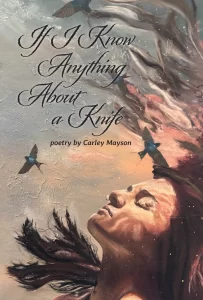
If I Know Anything About a Knife
by Carley Mayson
Frontenac House (2025)
The need to be honest about one’s torments, from addiction and self-harm, to relationship pain and the horrors of seeing a loved family member descend into dementia, is at the core of Carley Mayson’s debut collection. As she states bluntly in the poem, “On Being a Week Sober,” the truth is that “nothing lies like an addiction.” As a reader, having been in relationships with addicted men, I can vouch for this ouch of accuracy.
While rarely a proponent of “trigger warnings” as I think that those who turn to poetry are generally able to process most subject matters, I will still note that If I Know Anything About a Knife is not easy reading. While there are balancing poems of solace such as the couplet piece “Prayers to the Moments In-Between” that list simple redemptive pleasures like “a long walk in the snow, a dog’s nose/new books, clean sheets on a made bed,” or paeans to erotic and supportive partners, most of the book is necessarily relentless. If you read poets from Sharon Olds to Lynn Crosbie and Beth Goobie, Mayson’s poetry will serve up similar risks.
Beginning with glimpses of a childhood scarred by a father’s death, birds flit hauntingly throughout, often as symbols of vulnerability: a canary in the coal mine of her grief turning into a “yellow bird…[that] sharpened its beak on my wrists and ankles,” while later on she morphs into a “red-eyed sparrow, all out of songs, hoping for a resurrection.” The final haiku reminds us too of the danger of windows she began the collection with but now underlines that “the songbird won’t die.”
Mayson’s eruptive poems leap between lyrics and a haibun, a pantoum and breath-punctuated prose pieces. Some don’t work as well, like “Chamomile Tea” whose scattershot typographies “and I/ho/wlp/ani/c” twist discombobulation into unreadability, while others are a tad too marked by cliché (blood rushes, legs tremble, “sounds catch in my/throat”), an effect, along with the occasional romantically-flat endings (“you treat me so differently/than anyone else”) that gives the feel of song lyrics (perhaps most overtly in “Xanny” where Billie Eilish is invoked). Yet most pieces pierce. When Mayson converses with figures from Emily Dickinson to Gerard Manley Hopkins, or when she writes of rehab in “Withdrawal Cracked Me Like an Egg” then picks up on images of Solitaire, pills and yolk and replays them in a subsequent form so it becomes pain, redux, or when she recounts the agonizing narrative of her grandmother’s dying as she tries to resist the theft of “Benzos out of her open mouth,” the collection rises to that essential wound that poetry can be, needs to be, so we can enter what we suffer, wholly, and hopefully, heal.
Catherine Owen, a Vancouveriteedmontonian, has published 17 books in four genres. Her latest is Moving to Delilah (Freehand Books 2024), nominated for both the Al and Eurithe poetry prize and the Robert Kroetsch award. She teaches Poetic Forms at Concordia University of Edmonton, runs The Clio Project, a documentary series on older women artists, and edits and reviews from her 1905 home on Alberta Avenue.