By Bruce Hunter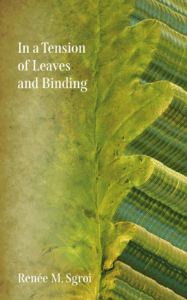
On a Tension of Leaves and Binding
by Renée M. Sgroi
Guernica Editions (2024)
I was first introduced to Renée Sgroi’s poetry online at the Oakville Literary Cafe recently. I was taken by her openness to science and her macro and micro views of life, as well as her moving poetry about grief. I immediately sought out her book In a Tension of Leaves and Binding and was again impressed by her delving into the Latin names of plants, her vast empathy for the world and its flora and fauna, large and small. This is her second book, but it has a maturity of voice, as well as a confidence with many different forms and styles including lyric, language poetry, list poems, free verse, documentary realism, odes and elegies, to name just a few. Whatever form she uses, there’s the sophistication of a poet who is an informed non-scientist in earth science with a passionate curiosity about all of language. In a Tension of Leaves and Binding has already established Renée as a poet of note. I provide her website below where you can check out some of the reviews of this well-received book.
How do you describe yourself?
In literary terms. I used to say “writer”, but since I now have two poetry books out, I say “poet”.
Who are your influences both contemporary and classic?
I think you mean for this question to relate to poetry although no doubt like you and other writers, I read other work too. I’d definitely have to say that Italo Calvino — can I say especially Calvino? Always Calvino? I think I‘ve read Invisible Cities at least four times already!
Dionne Brand, Lisa Robertson, Paul Auster, and Orhan Pamuk are certainly influential for me. Their books invite multiple readings. That’s a sign for me that they’re influential. In terms of poetry (because both Brand and Robertson are also novelists), I’d say Ellen Bass’s work, Kayla Czaga’s Midway, Sarah Yi-Mei Tsiang’s Grappling Hook, both of these two latter collections I have on my shelf to reread as well. And then there’s Louise Glück, Diane Seuss, Anne Carson. I haven’t ready everything published Carson, but I’m getting there. If I like an author’s work, I tend to do a deep dive. For poetry that has stayed with me, and in this sense, gets at the “classic” part of the question, Dorothy Livesay, A.M. Klein, Alden Nowlan, P.K. Page, Robyn Sarah. Oh, Gertrude Stein. I think I have a penchant for more experimental, or less lyrical work (also in my choice of novels), although I’d actually have to qualify that statement by saying how much I love Frank X. Gaspar’s Late Rapturous (I’ve read it twice, three times? I will no doubt read it again at some point!). I’ve just finished reading Susan Andrews Grace’s Hypatia’s Wake, as well as Michael Trussler’s Realia and 10:10. All three brilliant works. But I’m also about halfway through Samuel Beckett’s novel Molloy, and have his Watt on my list for the summer. Outside of Waiting for Godot (which I had to study more than once in university), Beckett, I can already tell is going to get his name on my “influential” list.
Can you tell us about your Italian heritage and connection to the language and how it has impacted your understanding of English and poetry?
Yes! I grew up knowing that my family heritage was Italian, or more precisely Calabrese, although when I’m asked now, I will generally respond that I have a southern-Italian background, which I think is an important distinction (at least for me) because of the historical exploitation and underdevelopment of southern Italy, which led to its own unique cultural characteristics. My parents immigrated to Canada before I was born, so the immigration narrative and the dialect of Calabrese was a huge part of my life. I guess I’d be considered a “compound bilingual” (English and Calabrese) because I heard both languages from birth, although English tends now to dominate in most family functions, especially as some of the older generation have passed on. In university, I took an introductory Italian class, and learned how much about the language I didn’t know, because my parents didn’t speak Dante’s Italian (which is the basis of standard Italian). And yet… There is definitely an underlying linguistic structure in my brain and in me that is Calabresi, which I’m finding increasingly apparent as I get older. If I’m angry, I’m angry in Calabrese, and equally, if I love someone, it’s the same. But yes, in relationship to poetry, I sometimes think that when I write, I’m unconsciously using a Calabrese syntactical construction, but just writing it in English. When I see this in my own writing, depending on what I’ve written, sometimes I change it, and sometimes I don’t. I know other writers have sometimes commented on my unusual syntax, and I really think that’s the reason why. It also explains why, when I took an introductory linguistics class in university, I was really great at phonology, but couldn’t figure out syntax!
You are definitely a gardener in your poetry. Are you also at home in the garden?
Thank you for asking this question! So many people have commented on the garden in my book, but I don’t think anyone’s ever stopped to ask this! Yes, I am a gardener. Not the type who’s out there in rain, sleet or snow (and kudos to you folks!), but I enjoy creating a space for plants to flourish, and with my husband, we’ve created some vegetable patches, as that’s more his thing. But I definitely have a green thumb, as nine times out of ten, anything I put into the ground will grow. And I have numerous plants inside my house too. Recently I rescued a little asparagus fern from the nursery that was on the “needs rescuing” shelf, and now it’s happily growing across, between, and above the poinsettia it lives beside, draping itself over the poinsettia pot, so yes, definitely, I am at home in the garden.
I don’t want readers to equate my relationship to the garden in any kind of stereotypical way that has to do with my heritage, though. I think it’s a trope, a negative stereotype that “all” people of Italian heritage “naturally” have a garden, or lots of plants in pots, or are growing tomatoes, etc., that probably has to do with historical bias towards the waves of immigrants to Canada, particularly in the 1950s and 60s. More importantly, it’s not actually the case, even if some people do like their tomato vines in their backyards! My husband is from Trinidad, so case in point, he’s the one who wants tomatoes, looks after tomatoes… As for myself, I don’t understand or see my relationship to my own garden through a cultural or heritage lens. For me, I think it’s more about how all of us as human beings exist, co-exist, as beings in a world that also includes plants. There’s something really grounding in the ability to be near, and live alongside plants, and when I discovered in my early twenties that I have a green thumb, it was much more of a communication, perhaps something that even led to poetry years later, that was important for me.
How did this book of poetry begin for you?
I think I am always writing about nature in some way (see comment above), or I had been for some time. I suppose I started to realize that I had a number of poems on a theme, so I started to put them together, and started to pay more attention to nature. And then my mom passed away. And then the pandemic hit. I was lucky that I had the ability and the means to spend the first summer of the pandemic just sitting in my backyard, reading and writing. And then in the summer of 2021, I was in the online workshop at Sage Hill, and that completely changed everything for me, including how I see poetry. And it was during that workshop that I also realized I wasn’t just writing about the garden, but I was writing about grief. I rearranged everything after Sage Hill, and I think the book took off from there, even though most of the writing was probably already done at that point.
So, I didn’t start out with a set idea, but instead, the book developed organically. Maybe that’s apt for a book about plants!
I was so moved when I heard you read the poems about your mother, I rushed to buy your book. Can you tell us about those poems? Did it help with grieving such a huge loss?
Oh, that’s so lovely to hear, Bruce. I really appreciate that. It’s interesting, because those poems are about my mother in some ways, yet they’re not. I was trained last year in the Amherst Writers’ and Artists’ (AWA) method, which always asks workshop participants to focus on “the speaker” or “the narrator” of a piece, rather than to assume that the “I” of any given text is the author. Even before I joined AWA, I was aware that somehow in the transformation of a lived experience into a poem, the poem was no longer ‘the’ experience, or was not simply a direct mirror of that experience (and after all, can anything ever be?). In order for the experience to become art, the words have to serve the needs of the poem, so details may change, a perspective may change, a feeling may change, or perhaps something else. I know lots of other writers have spoken or written about this, so I’m not saying anything inventive or new in this regard. Was it cathartic for me? I suppose in a way, although I don’t know that writing about our experiences is therapeutic, or that it alleviates feelings that are larger than anything we can put down on a page.
Others have mentioned your use of Latin names for plants. I love that too and your openness to science. Can you tell us how this came about.
I had been reading Dionne Brand’s The Blue Clerk when I was writing this book, and thinking about names and categories, and I think I am predisposed naturally to aim for precision in my work, which required me to learn the Latin names for the plants and animals. And as I mention in the “Of Binding” section at the back of the book, I do really love the sound of Latin, and how it rolls off the tongue. But as I said, I was reading Brand, and thinking about the problems of classification, the colonialist thinking given to naming flora and fauna (and Robin Wall Kimmerer’s Braiding Sweetgrass is so great at explaining how Indigenous names for plants and animals show relationships, rather than proprietorship), so it became important to try and split those names apart, even while recognizing that I too have been educated in that system, and am, in that sense, complicit. And then I was asking myself, how can I move or push against that?
You are a terrific supporter of your fellow writers through organizing events and participating in the AICW. Can you tell why this is important to you?
I certainly try to support my fellow writers! I think I’m a person who believes in community building, even if its on a very, very small scale. When I was president of the Brooklin Poetry Society (in Brooklin, which is a part of Whitby, where I live), I was able to get a website up and running, a poetry contest, an anthology published. I needed to pull back for awhile, and then I became part of the executive of the Canadian Authors Association – Toronto Branch towards the end of Covid, which was really great, and gave me a sense of contributing to a larger organization. For the past three years or so, I’ve been a first reader for Arc Poetry Magazine. It’s very behind-the-scenes, but it’s important work because it contributes to the poems that eventually get sent forward to the poetry editor, and make it into the publication. And I feel it’s been a real education for me, too, in terms of the poetry that is out there, so it’s a win-win! With regards to the AICW, I actually haven’t participated in too many events, as right now, it’s a bit of a challenge for me to be physically present as much as I would like, but I became an Amherst Writers and Artists’ affiliate last year, and have occasionally helped out with their online workshops, in addition to running my own workshops online, so no, I don’t have a problem helping out writing communities that I’m a part of as I think it’s important to make a contribution. As Louise DeSalvo wrote in her book, Slow Writing, “being a writer isn’t easy”, and it isn’t. We need all the help we can get.
What have you learned thus far that you would like to share with your fellow writers, beginning or established.
Keep writing. We all get rejected. Trust yourself. Listen. Read widely. Pay attention. When I say read widely, I mean really widely. Don’t just read the authors you like. Read those you don’t like too – you’ll learn from them. Don’t be afraid to explore, to invent, to play. Try something new. Share. Support fellow writers. Be a part of your local writing community or group. Look after yourself. It’s okay if you don’t write the best novel or book of poems, or whatever. It’s the act of writing that counts. A rejection letter shows you have your hand in the game.
What’s next for you?
Right now, I’m working with two other authors on a couple of collaborative pieces, so that’s at the forefront for the moment. I’m also booked to work with an editor on one of my manuscripts in early fall, but before that, I’ll be attending Sage Hill online again in July with a different project I’ve been sketching out. If I have time, I’d like to revisit a novel project that I haven’t been able to attend to for a few years (fingers crossed on that one). But I’m planning to take the summer off from offering workshops so that I can concentrate on my own writing and time for reading. I have a stack of books I hope to get through!
Bruce Hunter is an active gardener, writer, speaker and mentor. In 2025, his award-winning novel In the Bear’s House was rereleased by Frontenac House. In 2024, as Nella casa dell’orso, it was published in Italy, as was his 2023 poetry collection Galestro in 2022, A Life in Poetry, all by iQdB edizioni. In 2021, his memoir essay “This is the Place I Come to in My Dreams” was shortlisted for the Alberta Magazine Publishers’ Awards. In 2024, his eco-poem “Dark Water” won the gold prize for poetry for the same awards. Bruce’s poetry, fiction, reviews, interviews, translations, and nonfiction have appeared in over 100 publications internationally.
Renée M. Sgroi (she/her) has published two poetry collections, life print, in points (erbacce-press) and In a Tension of Leaves and Binding(Guernica Editions), the latter of which was on the CBC’s highly anticipated poetry books for 2024. In addition to FreeFall Magazine, Renée’s poetry has been published most recently in Room, Pinhole Poetry, yolk literary magazine, and Augur Magazine. A member of The Writers’ Union of Canada, the League of Canadian Poets, the Association of Italian-Canadian Writers, the Canadian Authors Association, The Ontario Poetry Society, and an Amherst Artists and Writers Affiliate, Renée is also a contributing editor for Arc Poetry Magazine.