
By Vivian Hansen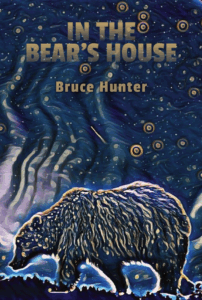
In The Bear’s House
by Bruce Hunter
Frontenac House (2025)
I read the first edition of this book in 2009 (Oolichan Books). I believed then, as I do now, that it is Hunter’s masterpiece. It has been translated into Italian: Nella Casa dell’ Orso (2024). When the first edition was published, the genre of memoir was struggling to own its place in CanLit. Awards were scarce, and the craft itself co-opted the conventions of fiction and poetry. In the Bear’s House challenges all those conventions in multiple ways. It is a breath of Bruce Hunter; the subjective punch of the disabled and marginalized. It is a redemptive narrative journey, as any memoir strives to claim in craft. It sees indigenous people with a knowing that adds an essential humanity.
While the book can pass as fiction, it is the raw memoir that affects truth. Hunter has set up a diptych narrative; Trout tells his story of deafness in the third person, while his mother Clare relates her first-person perspective. Clare is his echo/aha voice who guards his world. The two are intricately bound, and Clare provides the backdrop for Trout’s developmental journey.
Trout’s narrative begins: “His mind busy in solitude begins to enjoy itself” (17) and so we enter into the world of a deaf boy. Throughout the book, Trout focuses on a conch shell gifted to him. Via the conch, he ‘hears’ a world of his own making. His imagination is honed through seashells, and the conch becomes his metaphorical hearing aid. He wears his man-made ‘contraption’ hearing aid, but the conch brings the narrative into his alternative world.
Defiance and rebellion find Trout and his sidekick Kenny. They commit break and enter and dabble in the practices of a dangerous coming of age. Trout is sent to his aunt and uncle in the Kootenay Plains to change his directions, and it is there that he finds the sounds of freedom and new ways of knowing. While in the camp of the Kootenay, Trout learns to hear:
Inside the Medicine Lodge, the drummers started. Four of them kneeled and pounded together, and as they chanted, the small hairs stood up on the back of Trout’s neck. The ancient sound travelled through him, as the large circular drum reverberated and boomed, first through his feet, up from the earth, and then around him in the air and through his skin. Piercing cries came from the singers’ throats and he could feel the hairs on his head and arms spark as he listened with his whole body. He needed no hearing aid here on Kootenay Plain. (152)
Trout’s coming of age achieves the transformation from a disabled boy to a man who hears his heart and what will become of his world and his extended Indigenous family. As you read this memoir, you will begin to claim what Trout wants: the same sounds attached to your heart.
Vivian Hansen’s publications include three full-length books of poetry and several chapbooks. She has published essays in Coming Here, Being Here, and in Waiting. She also has a short piece in the Calgary Public Library Dispenser Series (2019) “Where We Surfaced.”