
By Tonya Lailey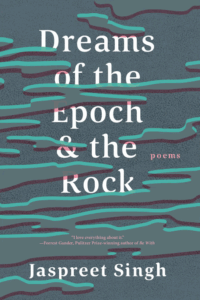
Dreams of the Epoch & the Rock
by Jaspreet Singh
NeWest Press (2024)
In “Dreams of the Epoch & the Rock”, Jaspreet Singh considers a vast range of terrain—climate change, decolonization, migration, language, time itself. Singh does this with the breathy intimacy and mind-altering strangeness of a dream.
A former research scientist with a PhD in chemical engineering from McGill, Singh has written novels, plays, short fiction and a memoir, all to critical success and wide appreciation. This is his third book of poetry and his eighth book. The poetic precision, craft and diversity of literary references in this book are impressive and effective, but it’s the deep love I felt in reading this book, love for the earth and its beings, including humans in our brokenness and destruction, that held me tight to its pages.
“What Will You Do Earth? when we are gone?, the poem on page 110 asks. There’s relief as the poem describes the earth healing itself after we’re gone, its geobiochem cycles reorder[ing] & cleanin[ing] / what is left behind. Then the poem brings us in, with witnessing faculties intact, reminds us of the ways we did pay attention, the poem invites us to see ourselves this way: But who will show you the pictures / of Earthrise as seen by your moon?…Who will sleep with rivers / in dreams? Who will / allow forests to change one’s heart?…
Singh does wonderful work with time, explores approaches to understanding it. A recurring theme is the brevity of human existence relative to that of the planet and other life on it.
“Breath”, a prose poem, takes human breath, one partner hearing the other’s ongoing breathing in bed, and follows it into a conversation about the Great Oxygenation Event some 2.4 billion years ago (p.7) A gorgeous levelling with human origins occurs around the question of why we seem to be so enamoured with dinosaurs but not so much with the bacteria that gave rise to aerobic life itself. The poem asserts, as if with an underlying admonishment to not be so deluded as to think otherwise, that planet earth was never holding its breath in anticipation of our arrival. Sapiens come so late in the history of things. Neither the planet nor the bacteria created oxygen keeping us or our opera halls in mind. All along Earth was not slowing “getting ready to receive us.”
Our place in time as a strange and slippery relationship inhabits poems in immediate, personal ways too. In “Photograph of My Father in Civilian Clothes” (p.104), the speaker remembers his father, how his face looked as if it could/ no longer recall the suffering / its younger versions endured. I hear a kind of awe and a curiosity about what a life can withstand, carry, move through, maybe even thrive past. I hear life’s healing powers, a tendency toward repair, toward love, in the story of the speaker’s father’s face. In part II, the poem brings the photograph to life in the day that is breaking. In the photograph it is morning as well, my / father and I have an entire day ahead of us. We are shown here how we live in layers of time, with the memory of other lives stepping forward with us – past, present and future together in a room’s morning light, a light repeated in the artifact from a morning years earlier. Time collapses itself in that final line.
In “No Llores” (don’t cry), the poem places the speaker in a cabin, with a door that keeps anticipating another arrival. There’s a song repeating, a song by Brazilian activist, singer, guitarist Caetano. The speaker is too preoccupied to change the tune. He is busy / figuring out / some efficient way to cry. The speaker is concerned about children, though doesn’t have any. The speaker remembers what a friends said those days we used to drink wine. It’s about the Aymara people, indigenous to lands now called Bolivia, Peru, Chile. To say “Don’t look back”, to the Aymara, one has to say “Don’t look ahead”. They face the past / The future is behind them. And in this translation, with utter efficiency, the inheritance of the Anthropocene is delivered.
The poem “Without Beds, Life Would be a Mistake” (p.6), gives weight to sleep, as if to say it could balance our waking lives if we let it. The poem recognizes the significance of what happens to us in this other place we tend to undervalue. The poem undulates down the page, suggesting sleep waves—theta, delta, alpha. I feel the bodies in this poem soften through their sleeping breaths, become embryos again / to learn that we belong / to a pack that can / never assume the planet / as a given. I appreciate the word “pack” here, how it infers that we gather as a species in sleep, in a collective knowing driven by biology. The poem confronts the conflict we have with our somnolent selves, ends with it: but every crack / of dawn we tear our- / selves apart eager / to forget the strange / things we got so near. The word “ourselves” is torn apart in that smart line break.
The book is rich in language, not only in English vocabulary, which is gorgeous, but in German, Spanish, Punjabi, Harákmbut. Cultures, too, if not their words, are specifically referenced and embraced —Persian, Peruvian, Brazilian, Chinese, Cree, Japanese. The language of science is both appreciated and questioned. The book is an international village united in a shared humanity, in our existential crisis on earth, a community of equal members living at the edge of time.
“I Sleep in the Nest of the Language I’m Learning” (p.25), begins by naming language as a window. The speaker expresses hope in language, in the secrets languages contain. Now I have more ways to describe light when it contacts leaves it helped make. More memory pathways to childhood’s blood oranges. The speaker also knows every language is fraught. Sometimes I wish the new language (like the old) didn’t come stained by histories. Erasing entire peoples.
I must mention “Coral Scientists” (p. 5) and “A Holocene Poem” (p. 11). “Coral Scientists” opens with a W.S. Merwin epigraph, three lines to break your heart before Singh breaks it again. The poem tells a marvellous, true story of how scientists revived a coral reef by playing recordings of sounds the reef made, thereby attracting life back to it, a literal clarion call to life. The poem ends with this line suggesting the limitations of our technological tricks to save life and pointing to the dignity and independence of other lives, how they move beyond our reach: But one day the sea creatures will learn / Learn to hear better and will not return.
“A Holocene Poem”, after William Carlos Williams, does a breathtaking job borrowing the tone of Williams” “This is Just to Say”, substituting thirteen mangos for the plums and a rising global temperature for the icebox, while staying true to Williams’ gorgeous sensuality and his acceptance of an indulgence, which in Singh’s poem is a much grander, longer one and chilling.
I can’t do justice to the wisdom in this book, to its beauty, to the undertow and buoyancy in its sea of feeling. “Window” (p. 13) delicately weaves references to Tomas Tranströmer’s poem, “The Half-Finished Heaven”, with allusions to Crawford Lake in Milton, Ontario considered to be “the golden spike” that marks the beginning of the Anthropocene Epoch. There are ghosts in this poem from different eras, ghosts whispering that we might have been looking into these windows, at the beauty and gifts of the earth, with interest all along.
Tonya Lailey (she/her) writes poetry and essays. Her first full-length collection, Farm: Lot 23, was released this year by Gaspereau Press. Her poem, The Bottle Depot was shortlisted for Arc Poetry 2024 “Poem of the Year”. She holds an MFA in creative writing from UBC.