
By Kathryn MacDonald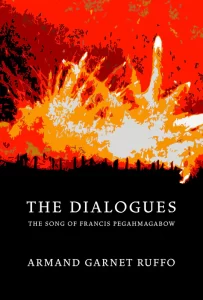
The Dialogues: The Song of Francis Pegahmagabow
by Armand Garnet Ruffo
Nishannbemwin translations by Brian D. McInnes
Wolsak & Wynn Publishers (2024)
Here is a story that does not end, but continues today in those who believe in a country where justice will prevail, as new generations rise up to fill the footsteps of warriors who have fallen long ago, whose sacrifices and legacies we continue to remember and honour….
(133)
Armand Garnet Ruffo has published poetry and prose, made films, and created anthologies in addition to his academic credentials. The various skills required for these successes come together in The Dialogues: The Song of Francis Pegahmagabow, creating a literature that is extraordinary.
The Dialogues breaks the boundaries of what we think of as poetry. In poetry, we expect “density of meaning, felicity of language, authenticity of feeling.” It should also “deliver to us…the sense of urgency,” and Ruffo gives us all this and more. We don’t expect the weaving of documentation through the book-length poem, but here it is, smoothly echoing the poetic voice of Pegahmagabow and that of the poet-narrator who occasionally intervenes. And as suggested by the title, this overlays the idea of musical performance. The demands of staying true to an historical life, while working within the constraints of the musical, has resulted in the unique the structure of The Dialogues.
The poetry, as we’re accustomed to think of it, is on the lefthand page. On the facing page are facts substantiating the poetics: sometimes it is in the form of the poet’s memory; sometimes in the form of a government or military document; sometimes a background statement as is “An Interlude to Discuss Francis’s Encounter” (35). As well, this collection weaves an actual musical score from the production that inspired this book (21).
The Dialogues is innovative in its narrative and story-telling, not only in its voice and in its structure but also in its immense impact. Reading it, I thought of Omeros by Derek Walcott. Ruffo’s scaffolding may not be created on a myth, but The Dialogues is mythic. Francis Pegahmagabow is a hero: in his soldiering; in his life after the Great War; and in his legacy. The Dialogues takes us on a time-journey, a culture-journey, a life-journey, from which I came away bruised but better understanding a life, a time, and a People in a “felt” way beyond intellectual knowledge alone.
Another poet who roamed about in my mind as I read The Dialogues is N. Scott Momaday, a man who led the Native American literary renaissance (c.1968). His illustrated The Way to Rainy Mountain – a prose poem, an homage – took me inside Kiowa culture in a deep and embracing way. We exit each of these books with a story in our hearts and held by something beyond words. This is what Ruffo does for the Anishinaabe of Perry Island, Georgian Bay. He shows us a man at the turn of the twentieth century, a “modern man living in two worlds” (31). Ruffo takes us far into the depth of Pegahmagabow’s culture and lived brutality, as well as into the inheritance of his People. Beyond that, Ruffo takes us toward healing and celebration.
There are two pivotal spiritual moments in Francis Pegahmagabow’s story. The first happens when Pegahmagabow (say Peg-ah-ma-ga-bow) encounters his Deer Spirit (22), the second, when he meets an “old Medicine Man” who gifts him a medicine bag – empowering, poignant experiences that change Pegahmagabow (34). They establish Pegahmagabow’s deep spirituality. They echo through The Dialogues.
In the second section, Pegahmagabow lives through the trenches of WWI. He tells us, “We ran straight into the storm / of machine gun bullets.” He tells us of “Boy’s, spilling out their guts, / calling for their mothers” (50). Should we have any doubt about the reality, the narrator tells us that “The average life / in the trenches / is six months. // He’s been dug in / for nearly four years” (62). It’s a gruelling time. He draws on his faith, and proves himself over and over again.
the enemy turns to a new killing tool: chlorine gas.
And the Canadians are without masks.…
The first attack creates havoc
General Edwin Alderson is desperateHe approaches Francis Pegahmagabow
who is crouched at the edge of the trench
oiling the breech mechanism of his Ross rifle.…
Is it true you can change the wind’s direction?
(8-14)
In the third section the decorated soldier-hero returns home, lost and bewildered to face racism and poverty. The Deer Spirit, who has lent his strength to Pegahmagabow, entreats:
Let us mourn
for the ones who died
were resurrected
and returned
abandoned
and forgotten
in a country
they no longer recognized.
(66)
Francis is broken:
Equality
in the trenches in a time of need,
but now I’m back at the end of the line
with barely enough to feed my family.
(74)
We are reminded of
A time when everything Indian
is banned and shunned,
his people are subject to the whim
of the Indian department
(76)
The Indian Agent repeats a recurring line:
I’ll see what I can do. Time’s up, I’ll get back to you.
(78)
In 1946, there were protests. I learned that Francis Pegahmagabow “attended a secret meeting in Biscotasing, northern Ontario, after returning from “the first parliament of the National Indian Government in Detroit” (83).
For a while, Pegahmagabow was chief of his people,
Then it is over.
Francis is voted out of office.
He joins the peacetime militia
and feels the old camaraderie again,
his medals pinned to his chest.
(84)
The final section, takes us into the performance. By now, we can imagine the stage, the musicians, the readers in an arc, hear them, and listen.
In the afterward, Ruffo tells us that he was “initially hesitant” to accept the invitation to write the libretto for a musical to celebrate the life of Ojibwe-Anishnaabe WWI sniper Francis Pegahmagabow. He also says that he became convinced by Larry Beckwith’s rationale that “Truth and reconciliation was central to the project, and in that light having a non-Indigenous classical composer and an Indigenous poet-storyteller made sense.” Ruffo “signed on.” We – the lucky ones who have seen the performance and those of us who read the book – are the beneficiaries of this result: The Dialogues: The Song of Francis Pegahmagabow.
I’m hoping you’re wowed with the woven complexity, the direct dialogue, the writing between the lines that Ruffo has given us. The Dialogues is a spiritual and earthy story of one man and his culture in a time of local and global upheaval. It is an adventure story, a hero’s story, a sad, yet hopeful story. I recommend it to you without reservation.
Kathryn MacDonald is the author of Far Side of the Shadow Moon and A Breeze You Whisper. Learn more about her work at kathrynmacdonald.com