
 By Beth Everest
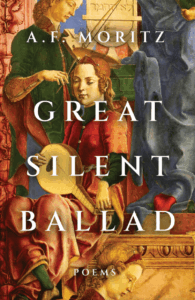
Great Silent Ballad
by A.F. Moritz
House of Anansi (2024)
The 22nd book of poetry by A.F. Moritz is not a quick read. Nor should it be. Like much of Moritz’s earlier work, Great Silent Ballad is very much a meditation on what is poetry, especially exemplifying where and how a poem does arise. It is in these meditations that the reader will want to rest and savour the impact. Take the beginning and the end of “A Muse” (10-11), for example:
The sullen stiffness of the flute, metal on which
the flicked fingernail clicks…the stiff
vainglory glinting blind silver in the sun…
played, it sends out a stream that is nothing but water’s
invisible sinuosity…
….
Such is the playing of the instrument.
Such is the dance in its first step before
a step is taken, when you, goddess vowel
of the beginning, begin to word the lyric.
Note here, not only the musicality of each line, the fluidity of the alliteration, but also the images that slide so easily from one to the next. One can almost hear the flicked fingernail clicks, almost feel the first step before the step. The images stop us, arrest us. The sensual experience prompts the poet to word the lyric. It is in poems like these that Moritz works his magic.
The poet finds the muse not just in beauty. Mortiz is quite well known for the startling contrasts between beauty and violence. In “Mentioning” (42) he speaks of the poets who “aspired erroneously / to convert himself into soul … contemplation to l’esprit pur.” And then in pure Moritz fashion, a few lines later, the poet slams the reader with the following:
…like some dog could not help turning aside to,
a teddy bear, a watchtower, the mother shattered in the bombing,
the innocent stumblers being herded toward a train or
disappearing
into factory hangar doors or timber-propped mine mouths
the fox kit in its fur, a smashed ant, its front half still struggling.
How can the reader recover from such brutal imagery? It is pure, very real, and horrifically apt.
Happily, the poems aren’t all violent. Some balance humor, curiosity, and the very serious. “Coffee” (117) begins with the line, “No one before the discovery of coffee/ever woke up”, and “A Poem Written in Real Time About What I was doing As I Wrote It” (119-20) begins with “I was eating a cookie…). Both of these pieces are actually serious contemplations of the so much other that is overlooked or at the very least given no necessary notice. Moritz suggests what we didn’t see. And therein lies the art.
Thematically, the book holds together. Silence, as expected from the title of the collection, is a critical component of Moritz’s poetry, and I would argue of poetry in general and perhaps of most art. He holds to the argument that what you say by not saying it and what you don’t see/hear are often more poignant than what you do. The artist brings the reader to the image. Perhaps this is Moritz’s definition of what is beauty, of what makes great art. He says /shows this in many instances where the “myth, the poem [came] to lead me / out of the hells of falsehood of its own Arcady / into the sudden opening of the eyes” (“Why Do We Read” 30). Into the sudden opening of the eyes. Is this not a perfect defining moment of great art?
Some of the poems/ballads in Moritz’s book refer to works of other artists, paintings and literature of which the reader may nor may not be familiar. For this, the poet provides several pages of endnotes after the final poems in the collection. For example, in “A Woman in a Painting but Not So” (17) Moritz refers to the painter, Corot, and in the endnotes (128) explains how the poem tells of a painting that Corot might have done, but didn’t, sometime in the 1800s. Another lovely contradiction. While some readers might find it tedious to be flipping back and forth to and from, the notes do provide additional depth to the work, some in a mini-essay fashion. Again, the greater understanding furthers what what Moritz intimates about the muse:
…Corot was not there
That torpid dawn—when was it, 1750…
1350? Only the squelch of her footfalls,
slap of small waves, wind ruffling. Still
…
And something else,
unheard but part of the quiet
of vision of her
in which she does not appear
She does not appear. At least not in the painting. But she does in Moritz’s poem. Again and again, Moritz suggests to the reader what isn’t seen, heard, thought. In fact, the book could be considered a meditation, essay or definition of not only what is a poem, but where is poetry. His meditations/ballads/poems are curious, interesting, and well worth the read.
Beth Everest enjoys the freedom to write, to create jewelry, and to dig carrots in her own garden. She is fortunate to publish in journals across the country, and occasionally come out with a book.