
By Megan Nega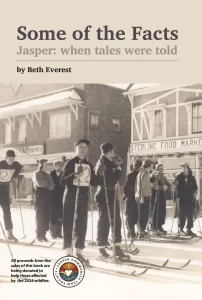
Some of the Facts: Jasper: When Tales Were Told
by Beth Everest
Frontenac House (2024)
Beth Everest’s new collection of short fiction about Jasper comes in the wake of the wildfires that swept through the town in 2024. Published as a fundraiser, all proceeds will be donated to help those affected by the fires.
In these 15 stories, we enter 1950’s Jasper as though we are returning home from a hike, with World War II still in the rearview mirror. Such nostalgic authenticity is achieved through sprinkling in some of the facts to establish setting. For example, in “Free to Drive,” we learn about the Lovats, an elite unit of Scottish soldiers who trained near Jasper during the war. In “Spit and Shine,” the narrator delivers a local newspaper, The Totem, on the morning paper route. And in more than one story, characters reference the iconic Sears catalogue, which was so emblematic of small-town life in Canada.
Truly, the down-to-earth realism of the setting and Everest’s incredible imagery made the stories wildly immersive. In “Ivy,” I felt I was right beside the park warden, observing the “sloping green meadow with paintbrushes [and]… tiger lilies and lady slippers” (24) while smelling the “wolf willow, sweet and sage” (24). And during the hike in “Free to Drive,” I could hear “the hollow echo of a loon” (60) and “chickadees singing their thing” (61).
Along with mesmerizing imagery, Everest’s writing is marked by expert characterization. Some characters weave in and out of the stories, becoming more complex with every appearance. Girty Brown is one such character. Each time I met Girty, her unpleasant nature was revealed, little by little. In “Bonds,” during skiing lessons, Girty doesn’t care that her friend Marjorie gets seriously injured, saying: “that old biddy… I can’t stand her” (22). After Marjorie leaves to get medical care, Girty insists that everyone simply “get on with the lesson” (22), proving herself to be severely lacking empathy. Later, in “Hanging Out to Dry,” we encounter Girty again when Owen—an introverted man—asks to borrow her car. She agrees to loan it, then “pats him on the leg and leaves her hand on his knee” (94). The moment deeply disturbs Owen, and from then on, I couldn’t help but give Girty my own nick-name—dirty Girty.
Other characters are featured in only one story, but the crafting of character remains impeccable. For example, in “Call Girls” we meet two young women whose girlishness is established immediately. The duo meets while waitressing at the Cantonese restaurant, frequently getting in trouble for “giggling like mad” (34). Further, the narrator revels in wordplay, taking child-like delight in stacking rhymes with her boyfriend’s name. She calls him “Handy Andy Pandy” (33) because he’s cute and strong like a panda bear and good at fixing things up. The stream-of-thought narration style also enhanced characterization and highlighted the immaturity of the women. To illustrate, the narrator says her roommate, the call girl, “knows everything about everyone and tells me it all, but it’s confidential” (35). I was entranced by this silly duo, and the tension between the naïve girls and the somber situations they find themselves in was enthralling.
Furthermore, the conflicts and actions of the characters throughout the stories were always engaging. I imagined myself right there with them—getting robbed at gunpoint, driving down a dirt road at midnight in the middle of a snowstorm, pushing a rude neighbour right off his porch, getting struck by lightning on a roller-coaster, and even getting chased by a bear.
In fact, bears are an ever-present threat throughout the collection. Real or imagined, bears are there, reminding the characters that if human law doesn’t get them, natural law will. This is the case for Bill in “Free to Drive,” who wakes from a nap to a grizzly attack. It chases him up a tree, mauling his prosthetic leg with “paws … bigger than platters. Claws digging [in]” (63). The grizzly punishes Bill for lying to the people of Jasper and allowing everyone to think he’s sailor or soldier, losing his leg heroically at war or sea, when he really lost his leg by driving drunk and getting into a car wreck that also killed his friends. Further, in “Spit and Shine” a “massive white bear [appears] in the middle of the road” (71), judging the narrator for illegally ice-fishing.
Prominent themes of dreams, illusions, and lies united this collection. In “Spit and Shine,” Freddie dreams of “margaritas and girls on a hot white beach” (67). In fact, he’ll do “anything to feed the dream” (70), even poach fish for some extra money to travel to Mexico. And the narrator, Freddie’s partner-in-crime, can’t trust his own eyes when he sees the white bear, saying “it couldn’t have been a bear out there in the winter, but it is so surreal that … [I] coulda believed anything” (71). And in “Small Town Girl,” the narrator shares her boyfriend’s dream of getting “loads of money and … [going] to Vegas” (107), and I felt her pain when that dream dies, when she realizes that her boyfriend abandoned her, that “he’s on his way somewhere else—Vegas maybe” (112). And in “Cold Turkey” a mother lies to her daughter about quitting smoking despite getting caught red-handed, holding a “lighted cigarette” (97). Truly, the interplay of truth, lies, illusions, ambiguity, and dreams within the collection made for rich reading.
When it comes to crafting narrative, Everest has mastered the art of opening and closing a story. The collection itself is treated as a complete narrative that begins and ends in doorways. The book begins with many doors opening in “Paper Route” as the narrator goes door-to-door selling tadpoles, and it ends with a fed-up mother letting the “screen door bang” (116) shut in “Ground Beef.”
Story after story, the endings expanded the narrative. To illustrate, in “Call Girls,” the narrator believes bad things happen in threes. But when the story ends, only two bad things happen, leaving her with a heightening anxiety, asking: “what’s going to happen next? What is the third thing? What? What is going to happen?” (39). Endings like this don’t end the story, just pull the blinds back down over the window we were looking through. We know there’s more. We know there’s a third event. We know the story isn’t over.
This, I believe, is the core of the collection. At the heart of Everest’s fiction, there’s faith that as stories are told and re-told, they become more true, more real, more open. A belief that no matter what, the story goes on—that Jasper goes on and on.
Megan Nega is poet, writer, and artist from Calgary, Alberta. Her poetry has appeared in the literary magazines FreeFall and New Forum. In her spare time, Megan enjoys visiting the mountains in search of wildflowers, watercolour painting, and sharing her thoughts about all things writerly and literary on her blog, Writer’s Hearth.