
By Michael Frey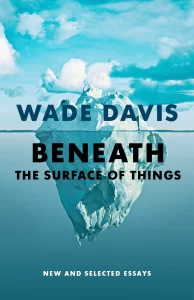
Beneath the Surface of Things
by Wade Davis
Greystone Books (2024)
Wade Davis’ latest essay collection “Beneath” offers a social perspective in both subject and style. Lying behind the collection is the implicit lamentation for our culture of truncated exposition and surface meaning. His title implies that we need to escape the apparent and look beneath, seeking is well worth the effort.
Each essay leaves the impression that beneath the essay, there lies a book in waiting. The subject matter is broad and moves from historical reflection to personal reportage, none of which seems out of place. The most difficult topics are the most effective, Davis manages to engage topics as divisive as the state of America, Climate Change, Jerusalem and Colonial Language with a rational and balanced treatment which confounds prejudice. Perhaps no better exemplified than in “Beyond Climate Fear and Trepidation” Davis pleads for rationality and balance in a debate which has polarized our world and yearns for solutions that are effective both practically and emotionally. In each essay, there is a plea for understanding, the real fruit of any exposition.
Davis deftly manages to illuminate the key to this nexus of travel and writing, mirrored closely to the nexus of exploration and conquering, that there are only two purposes to the activity, one to reinforce the preconceptions of ego or colonialism or the more preferred route of exploration to understanding and learning. If done correctly credit is given where credit is due, empathy as the key to human exploration, rather than acquisition.
The sequence of the collection reinforces the thematic of empathy and understanding. “The Art of Exploring” imparts the sense of respectful exploration which is followed “Mother India” which gives context for respect and humility in the time bank that is his India. Both essays deal with contact that could devolve itself into Orientalism but are saved by contact that allows empathy to flow into meaning. Through this deft treatment we understand that what we need to know of what is beneath is the lesson of empathy, meaning through connection, at which this author excels with fine writing.
Davis imparts to us metaphor without fanfare, as he begins with the presentation of the arrogance of the British Colonial endeavor; we find it fading onto history in comparison to the embedded culture of Varanasi which continues to flow as physical and spiritual history plays itself out on the banks of the Ganges. Empires come and go but India remains. Call it what you will, the name is irrelevant, it’s the practice that is the key to any culture.
The best of the collection surfaces as “Beyond Climate Fear and Trepidation”, the process is in the title. The title refuses the standard biased polemic on the subject, immediately we are aware that there is a minefield of emotion ahead for the reader. From whatever perspective you arrive at the subject there is room for you to be both right and wrong as you move through the piece. Davis’s tone of clarity and compassion is not for the subject but for the people having to navigate the subject as no one can be untouched by it. He manages to draw our focus inwards, rejecting the righteous polarity in favor of a much-needed conversation. He ends this with the same empathetic underbelly, though exploration of what is beneath the other we may find that remains is for us to do something together rather than do nothing apart, it is sublime in the face of fear and trepidation.
As in all the essays, his writing sparks curiosity that is prerequisite to exploration, speaking to intention of the whole or the individual. Curiosity is at the core of the collection, it is the bag we carry our questions in, from questions follow exploration and in succession to that we find meaning, and as above we are curious for more. Beneath is a story based empathetic model, an understanding of our observation of the difference between what we see, how we see and what we assume.
Michael Frey is an entrepreneur, an intellectual jack of all trades, and a renaissance man.