By Catherine Owen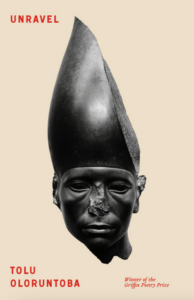
Unravel
by Tolu Oloruntoba
Penguin Random House (2025)
Unravel is a poetry of serious sonority, worthy of engraving on stone: lyrical, political, historical, scholarly, poems solemnly proud of their own deep powers.
Tolu Oloruntoba appears to be writing an exegesis of everything in one hundred pages of poems in two equivalent sections. The content ranges from African myths to Disney’s Fantasia, Camus to Huxley, Odin to Pygmalion and from colour theory to bonsai failure. Unafraid of demonstrating a massive capacity for knowledge, Oloruntoba unleashes the immensity of his erudition, including diction from his medical training (mitotic, olecranous), slang (hangry, sthlup), Nigerian and Latin and so much more.
In poems reminiscent of Pound, Brodsky, Moritz or Lubrin, and yet utterly his own melange of sources and sounds, Oloruntoba instantiates a world. There is a found piece, a lengthy cento that melds lines from poets as diverse as Terrance Hayes and Dorothea Lasky with Pope and Merwin, poems in numbered segments, prose pieces, a concrete poem in the shape of a tree, and many perfect stanzas. Poems are rife with questions (“Did I/place, or/abandon/you out/there? Think/the rain would do my work?), statements of poignant acknowledgment (“I’d thought hatred would save me;/ then I thought love would save me,/before I thought poetry would save me”) and quotations from writers, critics and DBT training manuals.
Some of my favorite poems in Unravel are perhaps his most quirky and least declamatory however, such as “Still Life with Bananas” where Oloruntoba nods to our combinative origins with a fruit that is “three-fifths of me, by DNA…your fingers are mostly water, like mine,” a banana also one of the “reluctant immigrants” that has suffered the “yellowing of ethylene rooms.” Or his tragic imaginings, as with Part V of the extended origin piece, “Discover,” where he speaks of “The Bison Supermarket of the Plains” that was “shut down by Europeans,” calling humans in another poem, “Demonstro,” merely sad beings full of yearning, “great apes who keep trying” or later on in “Secure Attachment,” creatures who “perch on our achieved debris” (Oh that attentive ear!).
There is indeed such incredible largesse in Unravel that no review could even skim the surfaces. As a book, it is a palimpsest of so much reading and experience unique to this poet and yet imminently available to those who wish to slow down and absorb these vital poems. By the end of Unravel, we are emotionally unwoven, struck by the gift of a piece featuring the incantatory tenderness of a father who repeats the promise to his child, “I will, I will,” this mantra also resonating in the reader who knows she will return to these rich pages for their endless, gleaming troves.
Catherine Owen, a Vancouveriteedmontonian, has published 17 books in four genres. Her latest is Moving to Delilah (Freehand Books 2024), nominated for both the Al and Eurithe poetry prize and the Robert Kroetsch award. She teaches Poetic Forms at Concordia University of Edmonton, runs The Clio Project, a documentary series on older women artists, and edits and reviews from her 1905 home on Alberta Avenue.