
By Kathryn MacDonald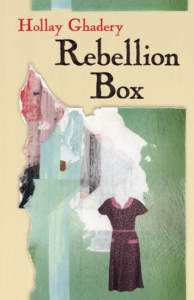
Rebellion Box
by Hollay Ghadery
Radiant Press (2023)
Perhaps one shouldn’t judge a book by its cover, but the cover of Rebellion Box is revealing. The illustration is dominated by a housedress trimmed in pink upon a paint-peeling background exposing an opaque scene that leads the eye to another and another. This, in a way, is what the poems do in Ghadery’s debut collection.
Opening to the first poem, “Postcard, Santa Maria,” we meet a girl, sensuous beside a pool, but then, a disclaimer: “I’m not that girl / anymore.” This, followed by the surprise “the cervix / of a fifteen-year-old, / my doctor says. / Not bad / for four kids” (1-2). And so, we are introduced to the speaker of many of the poems that follow, and a dominant theme of the collection is identified. Who is this woman who once lay by a pool in sunshine, who is a mother, who we will learn is biracial and bicultural, who attends historical talks, who writes poetry “to get [her] thoughts straight,” as suggested in an article Ghadery published in The New Quarterly.
In that article, Ghadery refers specifically to the title poem (45-46), a sestina, in which form controls and shapes the poem – a box as it were, for sharing the 1837 love story of Joseph, prisoner of the rebellion, and his love, Mary. The form disciplines Ghadery, allowing her to reveal the “mores and values” of the time in a tight, coherent way. Those mores and values are a constraint for the protagonist who cannot approach Mary directly, and I wonder, as I read through the collection time and again, if the Rebellion Box hasn’t become a metaphor for the constraints experienced by the poet herself.
In the poem, “Rebellion Box,” Ghadery takes us into history, but in “Patient 31,” she explores a contemporary event and a contemporary situation. Here, “a member of a fringe church / infected thousands with a virus,” but “You were // half listening the day / you heard it on the news.” The poet/observer is absorbed in motherhood:
You’d stood
in the living roomlooking at the baby’s toy
farm on the floor:
chickadee chatter and
your children’s laughter
risingfrom the yard
like the scent of apple
bread you’d baked
for lunch
and you know
your children are
getting older, soyou lie
in the night
trying to remember
the last time you looked
into their eyes,…. (“Patient 31, 16-17)
It is in these domestic scenes we fall into the core of the collection, the everyday scenes with children at the centre, the palpable love. It is in the motherhood poems I feel the deepest emotion rise through the words. Other favourites in this mode are “Mom” (8) in which we feel “An umbilical tug” and the passing of time. In “Cosmic Script” (29-30) “Your daughter knows darkness / is just the absence of light,” but “she / finds you / in darkness and climbs into your bed…” highlighting the contrast between what is known and what is felt/experienced. (The spaces indicate spaces/pauses in the poem’s format). “Cosmic Script” also explores the intimacy in the relationship between mother and child. In these poems scattered throughout the collection, readers are let “inside” where the tone is intimate contrasting with the more distanced emotion of those poems inspired by history, social context, the environment and so on. I’m thinking of the “for” poems. Those for Lucy Maude Montgomery (57, 58) or “Arosak (for Adele Wiseman)” (63). For these and the more elusive references, the notes at the end of the book are appreciated.
“The 13th Step” is one of the poems where the note informed my reading. Without it, the poem is beautiful, but knowing that it is about Adele Wiseman’s creative process deepens my insight and appreciation.
The 13th Step
fresh crinkle of summer,
bent ray of
waterlogged light,
the darkest fish under
the docka scorched birthmark
on my father’s chest,
tectonic skull tickle of
daisy chains
of dandelions,
my best friend’s
buttercupped chinmy shoeboxed faith
in the mouth of every tulip
in windy-day leaf tangos,
in the penny-perfect slot between
my mother’s front teethin strawberries, sun-soaked
and bursting between fingers
like something
still alive
from all the ages
through which I’ve passed.
The final poem in the collection “Optical Phenomena” (65-66) is an angry poem, a poem brimming with a sense of helplessness over global warming, our self-absorption as the earth weeps. It is a poem that reveals Ghadery’s stubborn determination to see and her struggle to articulate all that is experienced. Her honesty, however, leads her to confess: “I wish / I could pretend / it’s not happening….” She doesn’t pretend. As in all the poems that precede “Optical Phenomena,” Ghadery unveils what many of us see only obliquely, or don’t see at all.
Kathryn MacDonald’s poetry has been published in Room, FreeFall and other Canadian literary journals and anthologies, as well as internationally in the U.K., U.S., and other countries. She is the author of Far Side of the Shadow Moon: Enchantments, A Breeze You Whisper: Poems and Calla & Édourd. Find her online at kathrynmacdonald.com.