
By Catherine Owen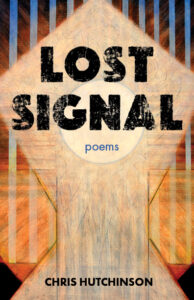
Lost Signal
by Chris Hutchinson
Palimpsest Press (2025)
If you don’t have an ear for the music of language, why do you write poems? This, the confused query that assails me when I peruse many leaden collections. Fortunately, Lost Signal is not among them.
Chris Hutchinson has been honing his assonantal antennae for decades now and his sixth publication, in four sections featuring a range of lyrical styles and one long poem in parts, sings an intellectual investment in engaged inhabiting.
In the piece, “What I Want isn’t Always What I Want to Want,” Hutchinson anchors philosophical musings on identity and yearning with a bookend of sunflowers, the final quatrain an echo of Wallace Stevens’ ballast of lyricism amid ‘thinkiness’: “I’d rather be cursed/like a field of sunflowers/seething with seeds/under a night full of stars.” I’ll be carrying those vowels in my blood awhile.
Lost Signal is unabashed in its homage to Stevens, overt in a superb piece like “Waving from the Shores of Key West” (and of course I hear the ghost of Stevie Smith in there too), that draws on onomatopoeic words like “squelchy” and more scientific terms like “matrices” to again question what the purpose of human creation is against the utter wonder of the ocean, each stanza a mere “tiny wind-torn flag.”
Part Two is a lengthier, fragmental meditation on aging and his father’s death, another acknowledgement of limitations in parameters, definitions, modes of expressing anything and necessary regardless even if, “…this is not a poem…This is just me/pissing and moaning.” A recognition that yields to the next section’s elaboration of other forms of loss and bond. Hutchinson weaves from curious statements such as, in the poem inflected by a Robert Frost epigraph, “Fire, Honey and Ice,”: “all my mentors are dead/or gone to beekeeping,” to the subtle unpacking of language because “No word ever says/exactly what it means,” the last line daring sentimental charges to show how the word “love” inhabits the word “clover.”
Such a willingness to be won over by sonorities is also evident in the gorgeous “Elongated, Waterworn Sonnet,” an Edmontonian adoration poem of river and a poet “lost/in the word pearlescent.” The final section might have been shorter, as the voice becomes, on occasion, an overly-familiarized reverberation from prior pieces, and I did wonder where the attribution to John Thompson’s “Yeats, Yeats” ghazal was in the poem that begins “Nietzsche, Nietzsche….” but Hutchinson remains a reliable traveler in exegesis and attentiveness, whether arriving at a “Motel 6/on the outskirts of Red Deer,” or recollecting “crushing Pong/zonked on Fruit Loops.”
The poems in Lost Signal truly locate semaphorical longings in everyone from a dyslexic skywriter to Diamond Tooth Gertie. A relentlessly erudite text, Lost Signal never forgets its child-like “why” or its need for the most sensorial of expression, the intimate witness, at the end, “falling asleep in my arms.”
Catherine Owen, a Vancouveriteedmontonian, has published 17 books in four genres. Her latest is Moving to Delilah (Freehand Books 2024), nominated for both the Al and Eurithe poetry prize and the Robert Kroetsch award. She teaches Poetic Forms at Concordia University of Edmonton, runs The Clio Project, a documentary series on older women artists, and edits and reviews from her 1905 home on Alberta Avenue.