
By Olga Stein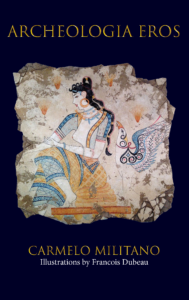
Archeologia Eros
by Carmelo Militano
McNally Robinson (2021)
Carmelo Militano’s poetry collection, Archeologia Eros, is divided into four sections or parts. They are as follows: “Eros’s Seasons,” “Fragment Shards Inseparable but Lost,” “Blue Guidebook Rome’s Starlings,” and “New and Old Archeology.” These titles reveal a great deal about the collection’s themes and subject matter. Together, they also suggest a structure and an overarching purpose. The poet-narrator intends to sift through numerous and varied layers of history that shaped his life and poetic output, such as the sediments of artistic expression that remain from erstwhile empires (the Greco-Roman worlds, although Militano also makes subtle allusions to the Persian/Achaemenian Empire, and China’s Tang dynasty), as well as the cultural remnants of a Calabrian community whose members immigrated to Canada in the middle of the 20th Century. By the end of the collection, the poet has indeed assembled the disparate but connected pieces/fragments he uncovered to relate a deeply personal account of love and attachment, loss, and efforts at reclamation.
Throughout the collection, Militano pays homage to the cultural heritage of ancient Greece and Rome that shaped Italians’ imagination, art, and architecture for some 1500 years after the dissolution of the Roman Empire. It’s from these peoples that we derive the sumptuous, transcendent lyrics of Homer, Sappho, Catullus, Propertius, Horace, Virgil, and Ovid (this isn’t a comprehensive list by any means). Militano, an Italian-Canadian, skillfully weaves into his work the passions and rich mythologies of antiquity, referencing their archetypal elements and figures while subjecting himself, as first-person narrator, to the erotic longings, heartbreak, and plangent fates we’ve come to associate with unearthed Greco-Roman artifacts and stories.
The poem “Caught,” for example, in the collection’s fourth section ends with: “I was caught by your voice between Apollo and Dionysus / The day you said good-bye.” Apollo and Dionysus, both sons of Zeus, have come to represent dual (contrary) tendencies in artistic expression. Accordingly, although the poet is distraught, he retains the Apollonian presence of mind to turn the experience of a breakup, with a woman whose “[w]ide beautiful smile, cigarette poised on [her] red lip-sticked lips” appeals to him, into a well-crafted poem, one that even gestures at “[a]n early black and white Truffaut film.”
This poem’s main setting is Florence of the present day, with its Ponte Vecchio (completed in 1345), its Renaissance-era Pitti Palace, and breathtaking views of “distant blue mountains,… the Arno / Lozenges of sunlight on the green grey water / The view so damn pretty.” The context may be a love affair that just ended, to the poet’s consternation, but what remains — the magnificent structures of preceding epochs, the natural beauty of Florence, and art itself — will endure, and will be admired through his and other poets’ work.
Mortals were always the playthings of gods, Militano reminds us in “Caught,” with the word “fate” slyly inserted in the poem’s third line, and with intertextual references planted in the collection’s numerous epigraph s, as well as the poems themselves. For instance, in the fourth section, “New and Old Archeology,” familial history is a layer/lens Militano uses to revisit and come to terms with his own hyphenated identity, both sides of which are formative, as he makes clear in the sequence of poems titled “The Fate of Olives No. 2”: “Inside me was the rolling invisible countryside / Of the Italian language / Spoken under a flat prairie sky…. God Save the Queen English was outside.” More broadly, the poet uses this section to reflect on his life, romantic relationships, and turn to poetry. Yet here too, myths from the past, as well as the destinies or fates they suggest, suffuse autobiography, adding depth and meaning.
Take “The Iphigenia,” a poem that alludes to Homer’s account in The Iliad of the sacrifice of Iphigenia, King Agamemnon’s deceived young daughter (she was told she’d be betrothed to Achilles, poor innocent). Vengeful Agamemnon is impatient to cross the Aegean Sea and begin his siege of Troy. Offering up the adolescent Iphigenia as a sacrifice to the goddess Artemis will get him there faster, he believes. In this poem, it is Militano’s Calabrian parents and aunt who are about set sail. In February of 1955, they board the Iphigenia, which is bound for the “New World” amid “‘[t]he smell of diesel oil, rotting fish and sea salt / A thousand years old,” at a port “[w]here even the February sun is ready / To betray you for a lira.” The immediate sacrifice, in exchange for safe passage across the Mediterranean Sea and the North Atlantic Ocean, is the “yellow and blue-stripped ball with red stars” the infant author throws at the dolphins swimming alongside the ship. Many more sacrifices will be made: all that goes hand in hand with immigration.
The more profound losses, the toll they take, are revealed in later poems, where the author delves into the lives of his parents, and what they relinquished by resettling in Canada. In “My Father Remembers,” Militano writes of his aged father, stuck in a room in Winnipeg during a Canadian winter: “Your histories are a warehouse of old emotions / ….Old Calabria gone / Instead there is a fake wood coffee table, beige couch, TV / Your front window covered with plants / Snow on the front lawn / Wind from the north-west cold and bitter / Your heart black.” Other kinds of loss, also bound up with memories of an earlier home and hearth, are made explicit in the poem “Spirit World” about the poet’s mother: “She missed the easy sun, warm air / Burned blue skies against low grey mountains / Her mother’s ironic smile in front of the stove / Speaking the round long E vowels of the Reggitano dialect.” Lines from another poem, “Winter Rites” (echoing Roman Catholicism’s Last Rites), are an elegy to both his dying mother and the Calabria of her youth:
Away from the tears, gasps and mournful sighs
Strange powerful voice of my aunt singing
Imploring the Holy motherTo make the New World what it could never be
An old mountain village for an immigrant heart.
Beauty is synonymous with loss. Or rather, as Ovid teaches, loss is the agent of change, beauty, the consolatory prize that follows transformation. Militano, an educator and literary critic, puts this principle to use again and again. His poems recover an ‘Old World,’ lost to his parents. The poet recaptures Calabria, its traditions and history of olive farming, framing them in redolent, beautiful lines of his own making.
Similarly, in “The Fate of Olives” (sequence #5), where the harvested olives serve as a metaphor for dispersed lives, the mature poet writes of being reunited after thirty years with a woman he loved, perhaps loves still. Strolling with her along the beach in North Vancouver, he sees himself as destined (perhaps by the gods) to live a peripatetic life, like Odysseus, inconveniently falling for unattainable women.
On this night full of faint stars and longing
Unable to recover the entire plot
Who you have become and why
My fate sealed ever after
To love sad eyed women
And their failed search for perfection
Along the shores of foreign cities.
In these lines, as elsewhere in the collection, beauty is engendered and remains due to poetry. A good poem is no mere consolation, however. It can signify victory over indifferent or disdainful gods; or, as Militano suggests, it enables the poet to conquer his own limitations — those of finite existence and capacity to recall places and people he wants to remember. “Architecture and Desire,” a poem in the collection’s third section, “Blue Guidebook,” tells us:
The poem is incomplete. He is uncertain, unable to recall her image. Her departure both an event and a non-event. A lost map of an ancient city. He knows his memory is what makes it significant or not, his art reality….She remains a wandering ghost; a series of fragments‘ tipped by the consummation of the swallow’s wings.’
The “Blue Guidebook” section is devoted to the poet’s experiences in different cities: Lisbon, Mexico City, Cannes, Barcelona, Hohhot, Rome, Cesena, Sestri Levante, Toronto, and Militano’s home city, Winnipeg. The poet isn’t accompanied by a lover during all of his travels, but he’s nevertheless prone to feelings of intense desire, which ancient Greeks and Romans called Eros, a force with Apollonian and Dionysian strands. Passion leads to poetic expression and beauty on the page.
There is an archeology to Eros, an intellectually complex, layered history that reaches back to ancient poets, philosophers, and art generally, as Militano indicates with his book’s title. Homer, Plato/Socrates, Lucretius, Ovid, among others, had clashing conceptions of amorous love and its effects. Plato’s Socrates exhorted lovers to temper their longings, envisioning Eros, when suitably disciplined, as an impetus to personal growth and a means to wisdom. Ovid, by contrast, suggested in Metamorphoses and other works, that for art to be sublime — terrifying and beautiful at once, and therefore intensely moving, electrifying even — it must have the element of mad, unrestrained passion and its emotional depths (Ovid began his Ars Amatoria / The Art of Love with a repudiation of Apollo’s spirit: “Nor will I falsely say you gave me the art, Apollo”).
For Militano, Eros is ultimately a generative force which transcends the carnal and its imperfections. He’s touched by Eros when exposed to different forms of beauty. In “Cannes,” he revels in the bacchanalian activity and excitement of the annual film festival. Describing how this scene stimulates him, he writes: “…/ I want to ask beautiful women if I should eat a peach, grow my hair. /….I want later to fly to Winnipeg Beach, write poetry, play Bingo / hear the lake waves fall like applause. Likewise, in the collection’s first section, “Eros’s Seasons,” where Militano aestheticizes physical desire and sexuality, the poem “Myth” (undoubtedly based on a coastal region in Italy) — with its “Sea green and sunset coloured bikinis / Cusp, fold, and cover their small grottos” — nevertheless conflates the sensual present of the seashore and its bathers with the splendours of Homeric epics: “Distant ancient boats groan with pleasure, sails swell / Voices sing a thrill and shrill song / To bearded men returning from a ten-year-old war.”
The poet’s pursuit of the past and its found fragments operates also on the level of form. In the collection’s second section, “Fragment Shards Inseparable but Lost,” he emulates the reconstructed, incomplete yet expansive poems of Sappho. Here, short poems are titled “Fragments,” and feature “[missing]” for words or phrases the poet suggests have been lost. This forces the reader to replace the lost words imaginatively. Militano explains these playful, postmodern-ish compositions in his Notes: “The hints of more by accident is tantalizing when it comes to desire.”
This section also whispers of Pablo Neruda. “Fragment 7” conveys the passage of time, nostalgia, and ambivalence concerning an ex-lover: “My memories surface; my mind like the ocean throws up different images, feelings, each one worn and made smooth by time like sea glass, the once jagged edges made smooth, hurt or love now clear and disconnected….I must have loved you that day.” Here, memory, the inner past, is made more discernible over time. The poet can ruminate on romantic matters with greater detachment but not utter certainty.
Militano offers meta-poetic commentary on composition, poets, who show up as lone figures in his poems (in “Biography,” he references with a wink at his readers, “[s]ome poems written by an Italian living alone in Fort Rouge”), and his own, perhaps unexpected, development as poet. In his overtly biographical poems, we get a glimpse of Militano discovering the expressive power of poetry as a young man, such as in “Winter Rites”:
It was many years before a boy read the poem
‘Who has seen the Wind?’….
Only later did I learn more about poetry and
its magical tricks
Pulled from an imperfect distillery called memory
Recognition, transformation, masks, evasion
Or maybe a better image: poet as a sly Calabrian peasant
We also see the adult poet struggling at times to overcome uncertainty, and yet resolved to go on writing. In “Biography,” the self-reflexivity is unmistakable: “With friends, coffee, cigarettes, beer / I listen for a word, phrase that will reveal myself to my self /….” What follows would strike any writer dedicated to their craft as a truth both trying and uplifting: “In the end my search came down to belief / Silence of this room blank paper / Pen in my hand moving across the page / Digital clock turning numbers all night.”
In “After Reading The Sad Phoenician,” a title followed by Robert Kroetsch’s question, “How Do You Grow a Poet?” Militano leans into his Italian working class roots to answer the question:
You grow a poet on Langside Street
Mrs. Cheekly on one side of the house
Blind father of the postman on the other
Pasta for dinner every Thursday and Sunday after mass
Tomatoes, beans, peppers growing in the back garden
To become a poet, Militano knows, one must learn to ask: “What is it that you have seen and what does it mean?” Finally, we see him half-laughing at himself, still baffled by the discovery that he belongs to the league of scribblers called poets. In “Application form for the job of Poet,” we see his amusement: “I am distracted by the usual list / Fey women a la Gatsby /…Doubts about the role of poetry /…” The poem continues:
What surprises the most
Is the repetition of the real?
This ceaseless habit
Writing on shadows
In the middle of a hot July afternoon.
Love in various forms — as physical desire, romantic and familial attachments, or the more spiritual affinities for certain places (Militano’s Canadian home, and the native land of his Calabrian parents), as well as poetic expression itself — binds the substance of this collection, irrespective of the layer or types of deposit the archeologist-poet is evoking. This is a lyrical, deeply affecting collection for anyone who has lived life, or is an immigrant, or can appreciate how the past informs the present.
Archeologia Eros is Militano’s third poetry collection. His won the F.G. Bressani Award for poetry for his first collection, Ariadne’s Thread (2004), and was shortlisted for the F.G. Bressani Award for poetry for Weather Reports (2012).
Olga Stein is a college and university instructor, essayist, and critic. Her debut poetry collection, Love Songs: Prayers to gods, not men, will come out with AOS Publishing in 2025.