
By Renée M. Sgroi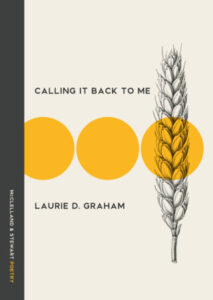
Calling It Back to Me
by Laurie D. Graham
McClelland & Stewart (2026)
On any given day, chances are good you might read or be fortunate enough to hear work by any number of talented Canadian poets. Sometimes, though, you hear work so grounded, so thoughtful in its questioning that you end up reading the entire book in one night. Exactly my experience this past National Poetry Month, after hearing Laurie D. Graham read from her latest collection, Calling It Back To Me (McLelland & Stewart).
An exploration of family history that collides with colonialism, Calling It Back to Me flows through four, longform pieces that interrogate central questions of place and personhood. The title poem, for instance, opens with heirloom, ocean-crossing steam-trunk chests whose “belongings / gone now,” (5), yet considers simultaneously “the processes occurring / within us and all around” (8). An apt beginning for a collection that explores ancestry as both oppressed and oppressor. Gender also figures in these poems, as the poet untangles what it means to be a woman, recorded for posterity as: “Just a married name, / a father’s name on a document” (6). The second poem, “The Great-Grandmothers” morphs beyond the book’s predominant couplets as the poet digs deeper into female ancestry. “Lily McClughan”, for instance, begins with a spacious meditation on a name that is “Hard to affix” (21) while “Sophia Czyzowski” by contrast is punctuated by brisk lines that describe this ancestor as someone whom “You would not want / to cross her” (26).
The third poem, “Toward an Origin Story” expands on the dualistic effects of immigration. The poem begins “Under Russia’s boot, / under England’s boot,” and pointedly observes the irony that: “they sailed off / to become the boot” (47). This clear-eyed, unsentimental swerve reveals a mind unafraid to explore tensions. The poet asks, “How can I speak / for this?” (48) and later on, “And we repeat on land / the wake they threw— / the churned grasses, / the razed overburden” (50-51). Haunted by these historical entanglements, the final poem aims for “A Good Closing”. Opening irreverently with “Mary so fricking full of grace coming out / of the Pizzaville, red envelopes of longing,” (61) the lines move towards a rubato as the poet acknowledges: “I’ve come to know / differently the passage / of time. I return and return, / recall ever more poorly/ the stubble, low poplars yellowing” (63). We are led back to the Prairies where the poet’s ancestors settled on land that was not theirs, back to the geography of a place with “the flat, flat water—” (72), which the poet acknowledges, even as she inks these images onto the page, she will one day herself no longer be able to recall.
Calling It Back to Me is a nuanced, intricate look at what it means to live as a settler in this country. These poems speak through a sophisticated, masterful voice that willingly opens itself up to a painful world, yet readily, humbly acknowledges, “But I can’t span it.”
Renée M. Sgroi (she/her) has published two poetry collections. In a Tension of Leaves and Binding (Guernica Editions), was twice listed on the CBC’s Fall 2024 Poetry Books to Watch lists, and was shortlisted for a 2025 International Rubery Award. Her third collection is forthcoming in 2027 with Frontenac House Press. A member of The Writers’ Union of Canada and the League of Canadian Poets, Renée is also a contributing editor for Arc Poetry Magazine.