
By Rosemary Griebel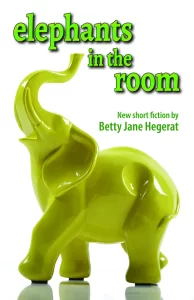
Elephants in the Room: New Short Fiction
by Betty Jane Hegerat
Shadowpaw Press (2025)
Betty Jane Hegerat is well known in the writing community not only as a respected teacher and mentor, but also for her skill in crafting engaging short stories. Hegerat is a masterful writer of character, place, and most of all the small things that are actually THE things that matter. Perhaps it is because of Hegerat’s earlier career as a social worker that she brings such empathy to her writing, transforming mundane, ordinary moments into compelling, relatable narratives.
Elephants in the Room includes fourteen highly polished stories. all which deal with the awkward situations, the unspoken or uncomfortable truths, the missed opportunities in life. In other words, the elephants in the room.
The collection opens with “The Queen is Coming” a story of a middle-aged son who takes his mother to view the Queen’s cavalcade in the 2005 royal visit to Calgary. The mother feels a strong bond with the Queen as she and the Queen were pregnant with boys at the same time, and both of their sons are named Charles. There is something so tender in the crafting of these parallel lives. The story’s narrator, Charlie, balks at taking his mother to see the Queen, but dutifully does so, his mother wearing an early replica of the Queen’s mink cloche hat which Charlie’s sister speculates is made from cat fur. The lacklustre son hasn’t chosen the best vantage point of the Cavalcade, but the mother motions her son to listen as she opines about the Queen:
“You look at her face, Charlie. She’s so…serene. How can that be possible with all the stress the poor woman has been through?”
I choke back a snort. “She has a bit of hired help, Ma”
“Oh, not that, she says. “It’s the children. The way they live their lives. What a disappointment that must be.”
I feel heavy, leaning there on my haunches, the weight of my own dull life hovering over Ma and me.
“I guess that’s just something that comes with being a mother,” I say.
“No, dear,” she tells me softly, without taking her eyes off the street. “Elizabeth has had bad luck with her Charles. Aren’t I a lucky old woman to have raised a decent man like you?” She turns now, and the smile takes twenty years from her face.”
Part of the magic of that story, as in all of Hegerat’s work, is the dialogue: the authentic exchange between the characters, and what is not said. Often the real story, and the drama, is just underneath the surface of the conversations in this collection.
Hegerat is also skilled at braiding wry humour with the everyday drama. In the story, “Unmasked”, Eldon, an older queer man who experimented with sex as a teenager, and accidently got a girl pregnant is waiting to meet his progeny for the first time. He reflects on how the mother of his child declared “father unknown’ on the birth registration and cut him out of her and the child’s life. “My Dad said I should be relieved. If I had been named and Inge had decided to keep the baby, I could end up paying support for years. In spite of feeling relieved—no longer having my nuts caught in a noose, as Dad so delicately put it—my teenage mind took a secret swaggering pride in knowing I’d fathered a kid.” When Eldon meets his daughter, he ‘had the feeling that under the mask she was looking at me like I just fell off the turnip truck.’ He goes on to say, “Look I’m sorry if I keep sticking my paw in my mouth, but I’m kind of lost here.”
The stories momentarily open the door on the lives of those who don’t quite fit in and offers deeply human portraits of the working class, the elderly, the isolated. Here we meet an angry foster child, a lesbian spinster teacher, a school kid dealing with the death of his bully, a grieving widow, a wayward brother. We are given a glimpse of the quiet struggles in day to day lives, and in doing so, Hegerat never veers into the sentimental, but quietly reveals the souls of complex characters.
It is often said that it is hard to write a great tragedy, but perhaps more difficult is to write a great story about the small happiness, conflicts, and internal transformations that happen in the lives of day-to-day characters.
Rosemary Griebel is an Alberta writer and librarian. Her award-winning poetry has appeared in The Best Canadian Poetry in English, as well as on CBC Radio, literary magazines, anthologies, and chapbooks. Her collection of poetry, Yes (2011), was shortlisted for the Gerald Lampert and the Pat Lowther awards, as well as the Stephan G. Stephansson award. Recently, her essays have appeared in Reimagining Fire: The Future of Energy (2023) and Ascenti: Humans Opening to AI (2024). In 2019 one of her poems was chosen for Alberta’s first literary landmark, as part of Project Bookmark Canada’s CanLit Trail.