
By Jonathan Greenbaum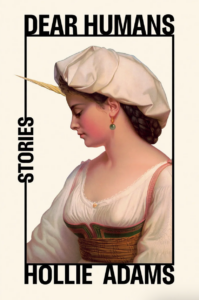
Dear Humans: Stories
by Hollie Adams
NeWest Press (2026)
Nowadays we pick up works of fiction that mix genres to achieve the author’s aims. Hollie Adams’ new short story collection, “Dear Humans,” exemplifies this. Her publisher describes the book as a place where the fantastic meets the hyper-realistic. Originally from Windsor, Ontario, Adams is a literature instructor at the University of Maine. She is the author of the novel, “Things You’ve Inherited from Your Mother” (also issued by NeWest Press).
Quirkiness is the word that best characterizes the thirteen stories in this collection. The narratives are mostly about career women. The tone and style of the stories have a minimalist flavour, like the early work of the American poet and short story writer, Raymond Carver (May 25, 1938 to August 2, 1988). Carver’s plots are memorable for their strangeness, though his one-dimensional characters quickly fade from memory.
“Eyebrow,” the second story in the collection, works on many levels. The first-person female narrator, Mary Watkins, tells us that she has “cat-sitted” Eyebrow, a pet belonging to her teaching colleague, Ben. We learn that Mary is fond of Ben. “[His] mismatched teeth, of course, no dealbreaker as far as I was concerned.” [p. 17]. And later: “I wanted to pour his scent [Ben’s] over ice and drink it.” [p. 19]
Some of the quirkiness in this story comes out in its humour. For example, Eyebrow butts his head into Ben’s shin and then abruptly turns away “to show us his butthole, tail curling like a question mark, asking for feedback.” [p. 18] Mary notices that she has a mysterious bump on her forehead. Strangely, the bump grows into a horn. Later, when Ben unexpectedly visits Mary in her home, he sees the protuberance on her forehead.
“I can’t explain it,” [Mary says]. “My doctor isn’t sure—”
“It’s so white,” [Ben] says. [p. 27]
Ben touches the horn. Then he and Mary undress. We are led to believe that they will have sex, as Mary wishes. Only at the last minute Ben surprises the reader. “Heavy-breasted and horned, I may be an obscene image, a vulgar teenage fantasy, but a fantasy all the same,” Mary says, thus concluding the story. [p. 33]
How are we to read this? Is Mary’s horn a phallic symbol? Ben touches it and seems to like it. Is this some kind of sexual role reversal? Or just plain fantasy? We are left wondering.
The narrative, “Like That but Times a Million,” is similarly odd. Sarah, the pubescent first-person narrator, tells us that her neighbour, Robbie, has lost his father. Sarah remains in her house to avoid seeing Robbie. Hoping to cheer up the boy, Sarah’s father invites him to swim in his pool. And swim Robbie does, lap after lap, refusing to stop even when the weather turns menacing.
The lightning flashes closer now but everything else is so very black and when I look up, it seems that more than half the world is sky. [p. 37]
This is very good descriptive writing. It portends what might happen to Robbie if he doesn’t get out of the pool. The story is told in different sections. At times Sarah wonders about death and other things. She cannot bring herself to tell Robbie that she’s sorry for his loss. What will happen? Will Robbie be struck by lightning and perhaps die like his father?
In the story “The Documentary We’ve Been Making for Fifty Years,” the narrator describes the vicissitudes in the lives of a group of friends who begin to shoot a very amateur film in the late 1960s. The filming scenes serve as a backdrop for a narrative about what happens to these people over the next fifty years. The ghost of a gorilla hovers over these characters (fantasy, again).
The story, “The Sessional Years,” is told by a first-person narrator, an English instructor named Britney. Britney is asked out by James, one of her adult male students. Later, James follows Britney to her apartment building. Is James really stalking Britney? A confrontation ensues between these two characters. Students stalking their teachers? This seems to be the “realism” that Adams’ publisher evokes.
I wondered about the “Dear Humans” of the title: is Adams addressing the characters in her own stories? Does she find them “endearing?” Or is the title a statement to the world at large that humans are dear creatures? (Never mind about the wars we start).
Hollie Adams tries very hard to create clever, hip female characters. Some readers may find this wit and hipness humorous.
“But if I let all those skeletons out of my walk-in, I’ll lose Poppy [my daughter], spend the next 5-10 taking communal showers and longing for non-Velcro shoes,” says the female narrator in the story, “Liking It.” [p. 104]
I confess: dialogue like this strikes me as flippant.
In sum, Adams’ narrators serve as vehicles to tell the quirky stories. I often wished that the stories, themselves, would be the vehicle to delve deeper into the hearts and minds of these women.
Jonathan Greenbaum, is a retired Ontario high school English teacher. A graduate of the Humber School for Writers in Toronto, Jonathan’s short fiction has appeared in The Nashwaak Review.