
By Beth Everest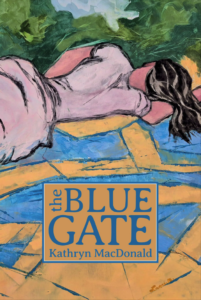
The Blue Gate
by Kathryn MacDonald
Frontenac House Poetry (2026)
From the very first poem in Kathryn MacDonald’s latest book The Blue Gate, the poet held me, transfixed, by stunning clean and clear imagery that melds the human and the natural world, rife with beauty and destruction. Readers are brought into a love relationship, but even in the opening pages, there are shadows of impending loss.
The first lines of “What she knew” (11) aptly sets the scene:
Love felled her like a tree
A robin’s egg in a windstorm,
A pretty blue thing
Felled is an interesting choice of verb, especially in the context of love, but it is perfect in this context. Felled warns the reader of upcoming doom, suggestive of a violent emotional blow, but fell also nods to the words fall and feel, and particularly in situations of love and death. Stanza after stanza in this book contains such harsh contrasts that are emotionally charged; compelling; unexpected; mesmerizing.
Take the birds, for example, and there are many species named, including waxwings, sparrows, owls, goldfinches. Most notably, though, are the red-tail hawks. The birds “nest,” an appropriate image for love. They dance, both together and apart. But many are birds of prey. It’s not all soaring fun. The images are both beautiful and horrific. From “Sky dancing” (24):
Sharp talons and beak
pierce my flesh, shred my heart—
death a bird of prey
And from “One hawk” (26)
I scan the cavernous sky
hollow full of lament,
startled that the sun has risen,
dogs need walking
birds need feedingIt is not waxed wings I need
but cerement
MacDonald’s rendering of love and grief is poignant, visual, tactile and heart-wrenching. Even the title takes on this role, but not necessarily in the way we would expect. Nothing in this collection is what we might expect.
Throughout The Blue Gate, we see blue in various tones/images. Not only is blue the visual colour of the gate that opens and closes, it is also symbolically “the colour of longing” (27), sadness and grief, and the tumult of “robin’s egg in a windstorm,” but it’s also “pretty” even as it blows in the windstorm, and visual like the lizard that “turns brilliant African bluu in August/ The month you died (56), and it’s reminiscent of the speaker’s time spent grieving in Kenya
where women in high heels (or barefoot)
walk elegantly – laden with burdens
perched like birds’ nests on their heads (59)
Blue is the burden that shows up again and again, contrast after contrast, always emotionally laden.
In fact, in the poem titled “At the blue gate I breathe” (38), the speaker of the poem wonders “Can grief be a perpetual falling.” A falling, a felling, a diving of the birds, and opening and closing of the gate. And then, the next few lines:
We race past gates
past gatekeepers
in lengthening shadows
The gate opens and closes, but not necessarily at will. Sometimes it stands closed, sometimes locked, or there are gatekeepers, or opened by the boy “who cannot leave” (60). Sometimes the shadows lengthen. Sometimes the gate just opens. But this gate is not an ordinary gate. It is blue. It stands between the before and the after. It is the division between what was and what is. From the beginning to end, it is blue. The poems in this stunning collection end with these lines (75).
Albinoni’s Adagio
rises
falls
swells
into fullness
slowly
cascades
into silence
to haunt
each blue
breath and still
I live (75)
Beth Everest enjoys the freedom to write, to create jewelry, and to dig carrots in her own garden. She is fortunate to publish in journals across the country, and occasionally come out with a book.