
By Carmelo Militano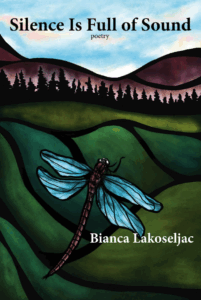
Silence is Full of Sound
by Bianca Lakoseljac
Ekstasis Editions (2025)
“You must be still in order to hear and see.” – Emily Carr
Set at the beginning of this celebratory collection of poetry by Bianca Lakoseljac, this perspective to the process of making art is what Lakoseljac brings to this finely crafted and stirring new collection of poetry.
Lakoseljac is by no means a new author, and her ability to hear, see, feel, smell, touch, and reflect, has previously been expressed in a wide and various range of books. She is a novelist (Stone Woman & Summer of the Dancing Bear), a short story writer (Bridges in the Rain), a poet (Memoirs of a Praying Mantis), and before her recent return to poetry, the editor of Rudy Wiebe: Essays on His Works.
Her latest work celebrates and praises a wide range of artists and landscapes, both natural and from antiquity. She creates Ekphrasis poems and mediates on romantic love. The breath and range of her poems, often accompanied with photographs, creates a dense, emotionally rich collection.
Here she is, for example, trying to answer the central question she asks herself on her quest to understand her encounters with various artists and their works:
How does one search for an artist…
He let me in
and once more I stood in the tiny room with no window—
just a skylight.
At Vincent’s Gravesite (21)
Lakoseljac is moved to write about painters such as Emily Carr and Van Gogh, musicians Glen Gould and Yo-Yo Ma, and the writer Ernest Hemingway, to name a few. She expresses a sympathetic connection with her fellow artists’ lives, their artistic process, their work, and struggles to be heard and find a public. Ultimately, her artist poems, both explicitly and implicitly, remind the readers, “… what mattered:/ creating art and remaining independent” is paramount for the artist. Her poems work as a dialogue with the artists she admires.
She talks to Glen Gould’s statue about books and engages with Emily Carr’s statue.
Your bronze in Yorkville tells your story without needing words…
The other evening,
As I strolled by you on Hazelton Avenue, out of the corner of my eye
I saw you smile
As I strolled by Emily Carr and Friends in Yorkville (15)
However, she is not always inspired by her pilgrimages or the statues of famous artists. Lakoseljac is disappointed when she visits Hemingway’s statue in the El Floridita Bar. Her ever-attentive and finely tuned intuitive antenna is unable to feel or see:
No intuitive thoughts
No flashes of inspiration
All I could “see” was his cold bones. (22)
This collection consciously or unconsciously takes up Ezra Pound’s dictum about finding the extraordinary in the ordinary. For example, Lakoseljac delights in the prosaic purple garlic “a fearless warrior” for battling all sorts of ailments, and she finds beauty repeatedly in the lake country where she lives: “come with me … to majestic Georgian bay…” or High Park in Toronto and the splendour of its cheery blossoms every spring. Her tone here is soft and amused, but also filled with rapture, especially in the beautiful, evocative, and contemplative poem The Temple of Poseidon.
The drama in these poems is not to be found in the poet’s ego, but rather in the observed vivid landscapes, the power and terrible beauty of a barren Arctic landscape, for example. Lakoseljac’s poems repeatedly “see” nature. One of her many strong suits is her ability to write about landscapes in a clear, precise, and imagistic language.
Lakes mirroring the sapphire sky
Rocky mountain ridges lining the horizon
And pingos–the volcano shaped cones of ice and sand
Rising above the sweeping lowlands.
In the Midst of the Arctic Tundra (71)
Lakoseljac is equally at home expressing the fun and thrill of being a grandmother poet or a downhill skier. She writes unabashedly and exuberantly about both. There is also a generosity of spirit and sympathy in her firefighter poems, which celebrate those who, with unrecognized courage and sacrifice, help others.
Finally, at the end of her collection, she writes about love, ancestral ghosts and their healing power, and friendship. These are the traditional topics of poetry. But, what unites “In Conversation: Love and Loss”, “Unlike Ophelia”, “High Park Grenadier”, and “The Stories I Tell” is that there is no irony, subtle or obvious, no fists raised, and instead a direct and sincere tone in admiration, for her ancestors or old friendships, or curiosity about whether forgetting past injuries means also forgiving. The question proves unanswerable, but the movement of the poem back and forth — the poet ruminating and challenging and questioning — proves to be an answer.
This collection succeeds in the artistic task Lakoseljac set for herself: to hear and see the world around her. From her stanzas of poetic space and imagination lift up the passions of art-making and the beauty of the natural world — in danger from the recklessness of our species. Lakoseljac is not a detached observer but a passionate and curious poet; one who wishes to show us the terror, joys and beauty of making art and documenting and celebrating — in a poetic way — the wonder of it all.
Carmelo Militano is the author of three books of poetry and five books of prose. His latest poetic work, Archeologia Eros, can be ordered online at www.carmelomilitano.com.