
By Kathryn MacDonald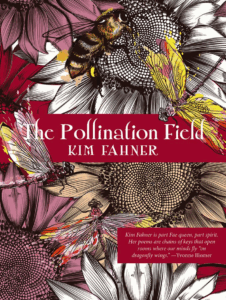
The Pollination Field
by Kim Fahner
Turnstone Press (2025)
The Pollination Field by Kim Fahner gifts lovers of bees and devotees of folklore (perhaps the first of the natural sciences) with poetry rich and layered. In these pages, Fahner confronts the immense time that bees have done the pollinating work that led to a riot of flowering plants early in the warm Cretaceous period through to today. The collection explores not science alone, it also revels in the folklore of bees, lore carried across the ocean by the Iris, Scots, and British diaspora.
In “A Bee in the House” (3), the speaker listens to “a baritone that conjures a bagpipe’s drone.” Fahner describes the bee as “Stained glass, those wings, like tiny windows / you look through, trying to find answers to questions / that have only been imagined….” She tells us, “A bee is good luck.” Here, in the prologue poem, Fahner establishes the overriding theme, the blessing of bees, and the searching tone of the collection.
While some of the poems, like the prologue poem, are lyrical, others flirt at being prose poems. Poems with long lines. Poems that present fact. It is primarily in these that we glean the science as we do in “Bee Grabbers” (68) that looks at the “chameleon” predator, Conopidae that inject their eggs into the abdomen of bees:
Ten to twelve days. Larvae that grow, silent invasive alien, and a bumble
that buries itself—headfirst, head in sand—before it dies. In between,
from start to finish: bee suckles, ignorant of false pregnancy,
internal parasites that mark its end.
However, look deeper. Conopidae may be metaphor after all: Lost is the “keen prospects / of lively offspring. Don’t look back; your conscience might / catch up to you, turn your ankle.” The poems in The Pollination Field can trip you up, tease you; Fahner’s poetic mastery creates a honeycomb of meaning.
Often the repetition of words and phrases stop us from rushing on through the poem we are reading. This strategy slows us down, points out something the poet underlines metaphorically, as she does in the third stanza of “Discoscapa apieula” (70-71):
Myanmar, one hundred million years ago, and a bee
visits a clutch of flowers,flies haphazardly into clumps of tree resin—is ambered for all time.
Beetle larvae on her body.Fossil bee now, ambered.…
One of my favourite poems in the collection is the sensuous “Queen Bee in a Tiny Yellow Box” (94-95), in which the apiarist carries a queen bee to a swarm that covers a bicycle. “[H]ow many bees, exactly?… // Two wheels. And … how many bees … exactly? The queen will gather many, many bees gone wild; she will create a new hive. Fahner is a master at controlling our attention and the pace of her poems.
This collection could not have been penned by Kim Fahner if it wasn’t ripe with reminders of Ireland – in its rhythms (think Shamus Heaney), Irish references, and feminist voice, as in “Sainted” (100-101) where the poet speaks directly to the saint:
Sainted
(for Gobnait)You came from Clare,
but the sixth-century clerics
didn’t record your work.
Men erased you before you could
even find a spare pen,
write things down.
Gobnait is the “patron saint of bees and beekeepers.” Her church, her monastery ruined, but…
In Cork, a stained-glass likeness
colours you tall and proud, dressed in blue,
a pale hand extended in reckoning.
Flick of your finger.
Flutter of bees’ wings.Your stings all stung—
in good conscience.Your soul, a bee rising,
resurrected.
My favourite poem in the collection, “Your Soul Is a Bee” (106) falls at the end of the fifth of seven sections:
Your Soul Is a Bee
Some night, lay yourself down in that field,
as if giving yourself to a lover—opened, free.Let your fingers dig deep down into the turf, so peat
gets under your nails —composts you before you know it.Sleep soundly, now. The earth will embrace you whole,
the wind will cross you in wet-dazzle from the see—holy.That old woman passing on the road sees you there,
just before dawn. Watches a tiny bee exit your mouth.She remembers, if you ask her, how the soul is a bee that
rises from the body—how it leaves one home for another.
In this poem, Fahner gives us sensuality, nature, time and decay, the old woman – central to her poetry – the bee, and folklore. It is a beautiful poem to read aloud. It is a poem to contemplate.
While the collection is comprised mainly of one- or two-page poems, The Pollination Field includes three long poems in the form of interrelated, carefully placed tales: one at the beginning, one in the middle, and the final poem near the end. They conjure the magic of ancient tales – magical, almost gothic at times. The first tale, “The Queen in the Bee-Loud Glade” (5-23) ends with “She will not be forgotten but remembered in wind-song forever” (23). In the second tale, the new queen bee is told, “Remember to watch your back, she tells her girl. You’re undoing me, / as someone else will undo you. You don’t believe it now, but it is true” (52). The new queen kills her sisters, “‘Sororicide’ sounds so much nicer than ‘murder’ (59). The “Third Tale: Coda—A Bee Reflection” closes the collection with poem “v) But Follow Your Heart” (129). There is a Saidie Hawkins dance and mention of wallflowers, but the poem sheds its disguise and “wonder[s] if the dance floor will still be there // in the morning…” clearly, an environmental poem (notwithstanding its feminist stance).
The poems in The Pollination Field by Kim Fahner attest to a deep understanding of bees and their role in fertilizing the plants of the earth. Like pollen, tantalizing facts are sprinkled throughout. I’ve learned that honey might taste like the fetid woods, or honeysuckle, clover, or apple blossoms. What I haven’t learned through the poems, I’ve learned through six pages of extensive notes – a valuable compendium.
Kathryn MacDonald is the author of Far Side of the Shadow Moon and A Breeze You Whisper. Learn more about her work at kathrynmacdonald.com