
By Vivian Hansen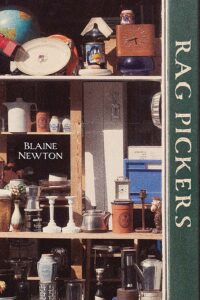
Rag Pickers
by Blaine Newton
University of Calgary Press (2025)
Thomas Trofimuk’s blurb offered me a guiding question on this review of Ragpickers: “I found myself re-reading these stunningly clever, and heartbreaking, and poignant stories and asking myself ‘How the hell did he do that?’”
I can offer some answers.
One might expect an accomplished playwright like Blaine Newton to create an exciting cross-genre experiment. His creation of deep characters, fine staging, stop motions in scene, detailing and sensory elements all form a part of his debut short story collection. Narrational rumination is a solid undercurrent, “Nouns are the first casualties –“, (45) and here begins the litany of loss within the stories. Even so, we visualize and retain. A witty dialogue between tense lovers:
She puts the gum on the end of her index finger and with a slow exaggerated gesture presses it onto the tip of her nose like a pink, masticated clown nose.
‘Stop it.’
‘Don’t you want me to look pretty?’ She twirls twice, her hands skyward, her hips swaying with each revolution. (61)
The dialogues move us to touch lines that change characters. This is an onerous and meticulous craft that Newton manages like a boss.
Settings become shadow characters; those that shroud Ben, who plants treasure for children in an average neighbourhood become extraordinary by the gifts he buries.
And through the yard wound a path. It was made of bricks made in a herringbone pattern – old bricks of a colour and type you don’t see anymore. His work took him to sites that were to be demolished to make way for change. He must have salvaged as many as he could carry back to his truck, placing them down on the rough soil, nurturing moss to fill the cracks between them. (114)
You can just feel the ground; the setting that nurtures the character and makes a map. Perhaps we can RagPick wit from setting sometimes, but Newton has a gift for it:
His office was clutter. Bookshelves lined two walls, from floor to ceiling, holding books that stood from all possible angles of equilibrium. More books were stacked on the floor, like African anthills or a literary Stonehenge, as though the light through the wood slat blinds would eventually align with the volumes to reveal a fundamental truth or at least the correct time. (133)
In the story One on One, you see and enter fully the mystery of a boy and a narrator: a particular twist of first-person point of view and omniscience. This presents as a starling scene of magic realism that permeates the story and calls us back to the rags of memory. They are bright, and they are salvaged.
The Cantos as story, are a gift. Observe: “The poets continued, including a sound poet who seemed to be suggesting that the core meaning of life could be interpreted in a vowelsome resonance reminiscent of a flatulent smoke alarm.“ (123) Newton’s wit overtures to the brilliant continent of short story.
And that, folks, is how he does it.
Vivian Hansen’s publications include three full-length books of poetry and several chapbooks. She has published essays in Coming Here, Being Here, and in Waiting. She also has a short piece in the Calgary Public Library Dispenser Series (2019) “Where We Surfaced.”