
By Catherine Owen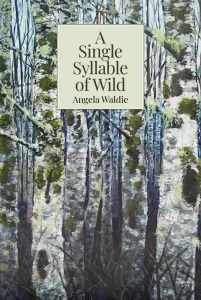
A Single Syllable of Wild
by Angela Waldie
Frontenac House (2026)
In many ways, the title sums up this first collection’s deep intent: to sound a singular and resonant note that fights for the wilderness. To that end, the most common pronoun in Angela Waldie’s A Single Syllable of Wild is “you.” In four consistently-lengthed sections, Waldie addresses forests, glaciers, birds, mountains and most passionately and tragically, bears. In “Bear 64,” the ursine is both watched by humans and disappeared by them, they give her a “radio collar” and a “faded plastic ear tag” and even dangerous “sandwiches thrown from cars” and take from her photographs, immunity, autonomy. Similarly, in “Bear 148” who was shot as she “crossed another border/she could not see,” or Skoki who was “banished from the mountains” and put in a zoo due to being habituated to humans, although some bears like “The Boss of Bow Valley” persist despite having been hit twice by freight trains. Waldie doesn’t flinch from baring our often-terrible incursions into the wild: as scientists, tourists “in air-conditioned cars” (Minnewanka), or just simply as clumsily-misguided humans. She extends the directive to “Please don’t touch the animals” beyond a signifier to a brute reality as with our meddling the “snow bunting could fall from the slender wire” or “The bison, in flicker of fear or fury,/might charge.”
Knowing the value of stillness, immunity, and silence for non-human creatures, Waldie celebrates how the pandemic freed them from us for a few seasons, and rhapsodizes in tones reminiscent of Gary Snyder or Don McKay of how we need to either vanish from nature or disappear into it by becoming “waterfall,” by leaving, truly seeing, pausing and learning “humility from mouse-eared chickweed,/and from tiny pink shooting stars” (High Water, Blakiston Creek). “Can we spare some space/for places still/just bird, wind and wildflower?” (Foothills Meditation) she keens, fully aware that of all our challenges as humans, simply letting other species be seems to be the most difficult goal and, when unachievable, deadly with consequences. Such as how global warming is creating the rapid retreat of glaciers, their hope the raven who carries a “frozen incantation” (From the Bow River, Calgary) for them in its beak. On occasion, Waldie over-extends an image, for instance by giving the wings of birds the quality of “empathy;” the general gist is clear but unnecessarily couched in an airy poeticism. Otherwise, her voice is pure and direct, and at times a bit monotonous as nature can be. She also experiments with many variants of free verse: stanzaic, visual, in numbered segments, and sometimes even writes a beautiful pantoum like “How Long do Forests Remember Fire?” or the enchantingly sad spell (heroic couplets within quatrains) of “Cascade” : “Spring torrent, summer vesper/autumn shiver, winter whisper/grizzly path, stone reader/Minnewanka dream feeder.” A stirring and essential debut.
Catherine Owen, a Vancouveriteedmontonian, has published 17 books in four genres. Her latest is Moving to Delilah (Freehand Books 2024), nominated for both the Al and Eurithe poetry prize and the Robert Kroetsch award. She teaches Poetic Forms at Concordia University of Edmonton, runs The Clio Project, a documentary series on older women artists, and edits and reviews from her 1905 home on Alberta Avenue.